Custom software vs. SaaS: when building your own really pays off
Your own app or an off-the-shelf tool? Clear decision logic, a worked example and a practical recommendation for mid-sized companies in the DACH region.
“Shouldn't we just solve this with an off-the-shelf tool?” – at DigifyNow we hear this question in almost every initial call. The honest answer: often, yes. But as soon as a process is truly part of the core of your business, standard software quickly becomes a brake. In this article we show the decision logic we use with our clients in North Rhine-Westphalia, Rhineland-Palatinate and across the DACH region.

When standard SaaS is the right choice
- The process is common in the industry (e.g. accounting, newsletters, a simple CRM)
- There are established providers with a fair pricing structure
- You need it quickly and it “just has to work”
In these cases, building your own is economic nonsense – and we say so.
When custom development really pays off
- Your process is your competitive advantage and cannot be squeezed into standard fields
- You pay per user or per transaction and are growing faster than the licensing model can take
- You are struggling with data silos between 4+ tools
- You want to integrate AI sensibly – see AI assistant
- You are planning to market a product of your own or a platform

A worked example: SaaS vs. building your own
A mid-sized company with 40 users can easily pay €60 per user per month for a standard solution – that is approx. €28,800 per year. With us, a tailor-made solution that maps exactly its workflow is often in the range of €20,000 – €35,000 for the one-off development plus approx. €200 – €500 per month for operation – supported through our Managed Digital Office. The break-even point is often at 12–18 months.
The pragmatic middle way: a hybrid architecture
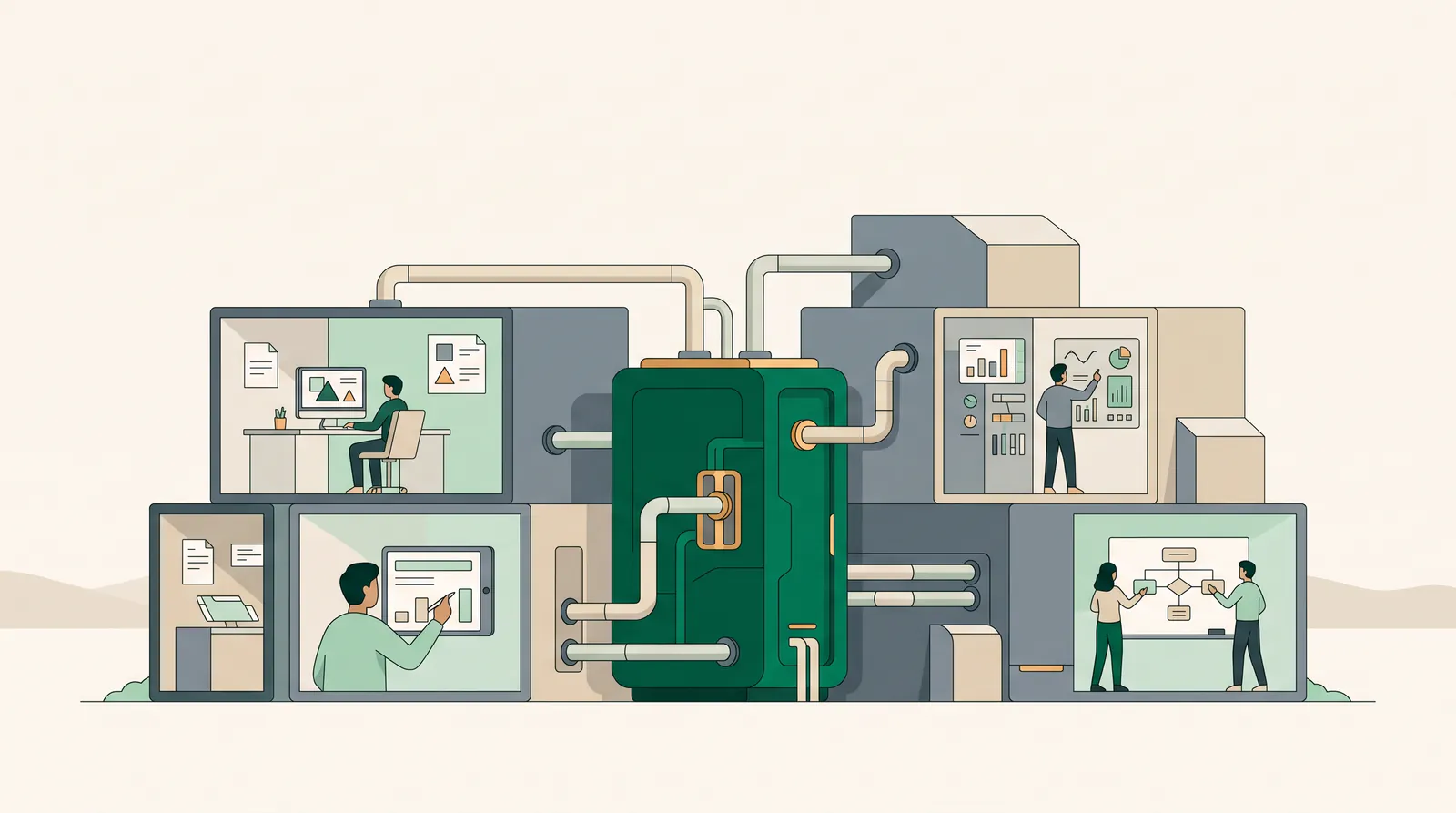
In most projects we deliberately combine both: standard tools for commodity tasks, custom software modules for the core. This is how solutions such as our own platforms AI Ad Studio (AI graphics & ads), LetterFlow (letter-mailing automation) and EmailFlow OS (email marketing) come about – each with clearly defined added value compared with the market. You can find more examples under case studies & apps.
What to look for when choosing a development partner
- A clear fixed-price framework for the MVP instead of an hourly-rate trap
- Weekly demos – you see progress, not PowerPoint
- Experience with AI and cloud architectures, not just WordPress
- A clean handover and operation – see our terms and conditions and operating models
- Regional proximity if you want it – for example our web app development in the Westerwald
Conclusion
The truth is almost never “everything off the shelf” or “everything built ourselves”. Those who do the honest math usually end up with a combination – with a clear MVP as the starting point and an operating partner who develops the solution further over the years.
Let's talk for 30 minutes
We review your project free of charge and without obligation – an honest assessment, not a sales pitch.
Book a callMore articles
AI agents in mid-sized companies in 2026: what really works
An opinion piece from project work: which AI agents hold up in mid-sized companies in 2026, which are pure marketing and how to get started sensibly.
Having an app developed and publishing it on the App Store
From idea to App Store and Play Store: accounts, the review process, common reasons for rejection and costs – with experience from our own app Festino.