Marketing Funnel: Stages, Examples, Tools
· DigifyNow
A marketing funnel describes how many first contacts turn into a few customers: awareness, consideration, decision, loyalty. It only becomes useful once every stage has a measurable transition, such as a page visit, a form, a booked call or an order, and once it's clear who or what moves the contact to the next stage. Build those transitions and the handoff to sales first. Then choose the tool: funnel builder, CRM with a marketing module, automation platform or a custom build.
What is a marketing funnel?
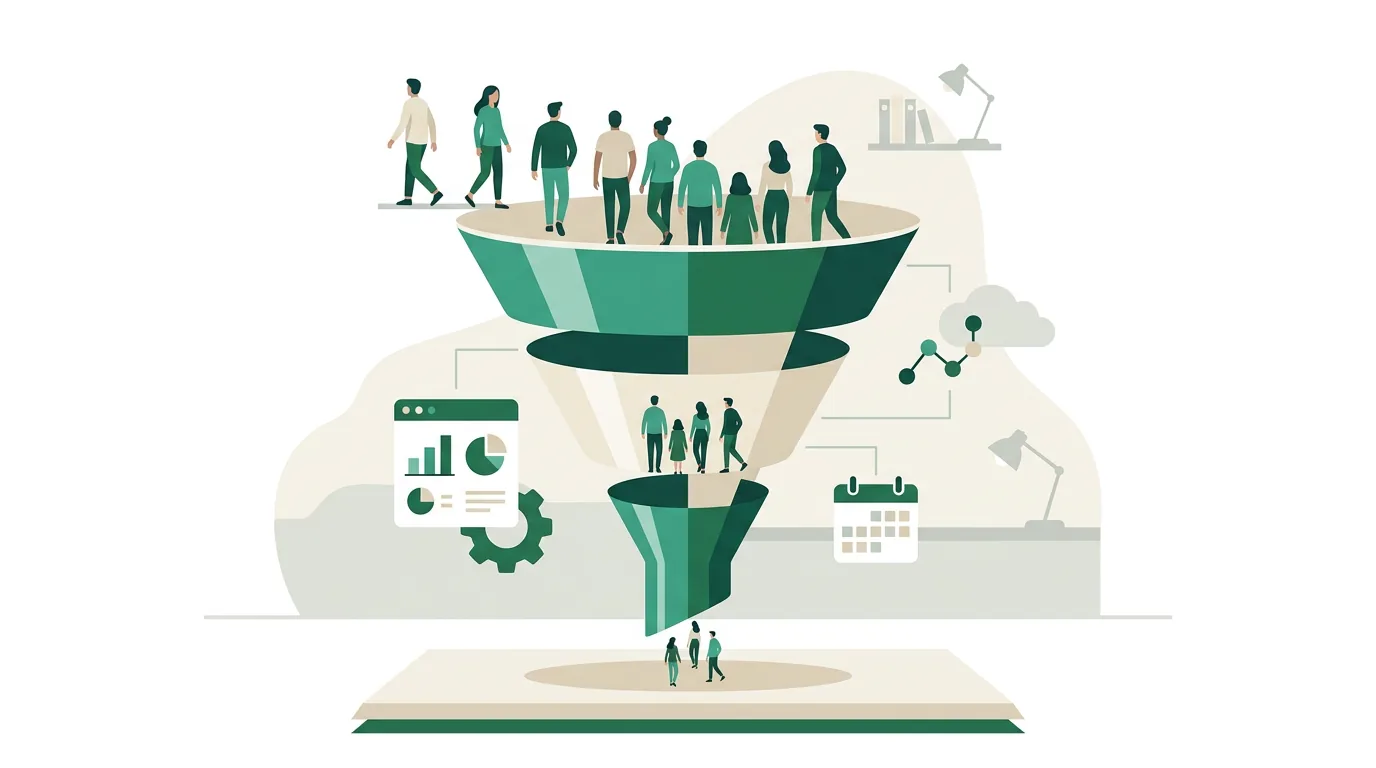
A marketing funnel is a model that breaks a potential customer's path from first contact to purchase into stages, usually awareness, consideration, decision and loyalty. Fewer people are left at each stage, hence the image of a funnel. It's useful when every transition has an event you can count, such as a submitted form or a booked appointment. That's the only way to see at which stage prospects drop off.
You'll also hear it called a purchase funnel or buying funnel. Along the way, some people lose interest, some aren't a fit, and some buy elsewhere. The model goes back to the AIDA framework (Attention, Interest, Desire, Action). Today most teams work with the four stages above, with the loyalty stage after the purchase added on.
It helps to separate the picture from the tool. As a picture, the funnel only says that customers move through phases. It becomes a working tool once each stage has an event you can count, for example a submitted form. Without that kind of event, you can't see where prospects drop off. And a sales funnel is not the same thing: it starts where a contact reaches your sales team and covers proposal, negotiation and close. The marketing funnel sits in front of it and ends with the handoff.
What are the stages of a marketing funnel?
Each stage answers a different question the customer has. That's why each stage needs different content and its own measurement point. The table shows the four common stages, what the customer does there, and how you can tell they've moved on to the next stage.
| Stage | Customer's question | Typical touchpoints | Measurement point for the transition |
|---|---|---|---|
| Awareness (top of funnel) | Is there a solution to my problem? | Search result, ad, social media post, referral, trade show | First visit to a page that belongs to your offer |
| Consideration (middle of funnel) | Is this provider right for me? | Service page, case study, guide, comparison, newsletter | Leaves contact details: form, download, newsletter signup |
| Decision (bottom of funnel) | Do I buy here, and on what terms? | Consultation, proposal, demo, shopping cart | Appointment booked, quote requested or order completed |
| Loyalty | Will I come back, will I recommend them? | Onboarding, customer service, post-purchase email, review | Second order, renewal, review or referral |
With longer B2B buying decisions, this doesn't run in a straight line. A buyer reads a guide today, disappears for three months and then requests a quote directly. That's why you judge a funnel by the conversion rates between stages, not by the total number of visitors.
What is an online marketing funnel?
An online marketing funnel is the same funnel, except the transitions happen digitally, which makes them measurable and partly automatable. Technically it usually consists of five building blocks: a traffic source (search engine, ads, social media), a landing page with a single goal, a form or booking tool, a system that stores the contact (usually a CRM), and an automation that sends the next message or notifies sales once someone signs up.
Whether the landing page does its job comes down to the headline, the length of the form and the load time. How to approach this systematically is covered in our article on landing page optimization in seven steps. Measurement still has limits: anyone who declines tracking in the cookie banner shows up in your web analytics incompletely or not at all. A funnel report therefore shows trends, not an exact count. What you can count reliably are the events that land in your own system: incoming inquiries, booked appointments and orders in the CRM.
Marketing funnel examples for small and midsize businesses
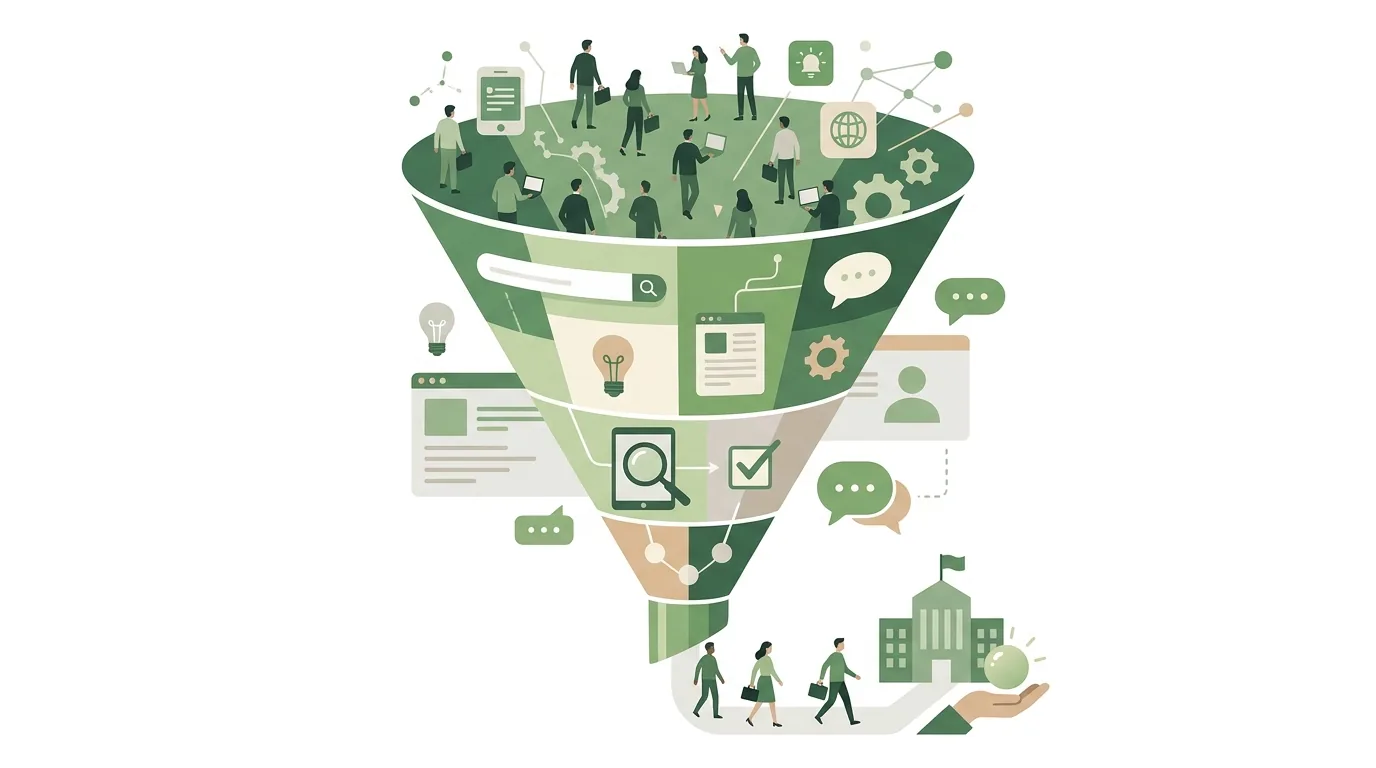
The three examples are made up and don't come from client projects. They show how different the stages look depending on the business model.
- Contractor doing bathroom remodels: awareness through a local search ad for "bathroom remodeling" plus the town name. Consideration on a page with before-and-after photos and a description of the process. Decision through a short form asking for ZIP code, bathroom size and preferred timeframe, followed by a callback within a fixed time window. Loyalty through a maintenance reminder. The measurement point that matters is the scheduled on-site visit, not the click.
- B2B manufacturer of custom machinery: awareness through trade articles and trade shows. Consideration through a technical data sheet downloaded in exchange for name, company and email address. That's followed by a short email sequence with use cases, and only with consent. It stops as soon as the contact replies. The handoff to sales happens when the company size fits and a specific need has been stated.
- Online store for accessories: awareness through social media and product search. Consideration on the product page with reviews. Decision in the shopping cart, where an abandoned purchase can trigger a reminder email to customers who have opted in. Loyalty through a post-purchase email with care tips and matching accessories.
What all three have in common is that every stage has exactly one next goal. When a page offers a newsletter, a catalog and a callback all at once, attention gets split, and afterwards you can no longer tell which path actually worked.
How to build a marketing funnel in seven steps
- Define your target customers and triggers: who buys, and what event makes them start searching in the first place? Water damage is a different trigger than a planned renovation.
- Define the end point of the funnel: what counts as success? An appointment, a quote request or an order. Work backwards from there.
- For each funnel stage, define one event that gets stored in a system, for example 'form submitted' with date and source.
- Set up the handoff to sales: what information makes a contact sales-ready, who gets it, and how soon do they call?
- Create content for each stage: at the top, answers to the problem; in the middle, proof such as case studies and process descriptions; at the bottom, a clear offer with a next step.
- Automate follow-up steps, but only where the process is fixed: confirmation email, notification to sales, reminder when there's no response.
- After a few weeks, compare the conversion rates between stages and change only the weakest point at a time.
Step 4 is the one most often skipped. A form whose submissions sit in an inbox nobody checks regularly isn't a marketing funnel, it's a leak. For automating the follow-up steps, our post on marketing automation with trigger, condition and action walks through concrete workflows.
What do you build a funnel with? Tool types compared
Four questions matter for the choice: where does the contact data live? How well does the tool connect to your CRM or ERP? Who maintains it day to day? And what happens to your pages and data if you switch? The table compares the tool types against these criteria. The products named are examples of each type. Features and pricing plans change, so for details, check each vendor's documentation.
| Tool type | Examples | Good fit for | Where it stops |
|---|---|---|---|
| Funnel builder | ClickFunnels, Systeme.io | Individual campaigns with landing page, form and email sequence from one source, set up quickly without a developer | Pages and workflows are tied to the vendor. Connecting to an existing CRM or ERP is limited to the integrations on offer |
| CRM with marketing module | HubSpot, Brevo | Companies that want to run contacts, sales and email marketing in one system | Costs often grow with contacts or users. Custom workflows outside the system need APIs |
| Website plus automation platform | n8n, Make, Zapier | An existing website and an existing CRM that need to be connected through workflows | Someone has to monitor the workflows. If a field changes in one system, the workflow breaks without anyone noticing |
| Custom solution | Your own web app with a database | Custom review steps, price calculators, connections to legacy systems, or data that should stay in-house | Highest upfront effort, plus maintenance and operations. Not worth it for a simple contact funnel |
A note on the examples: DigifyNow is a Make partner and receives a referral commission there. According to the documentation at https://docs.n8n.io, n8n lets you choose between the cloud version and self-hosting on your own server. The differences in billing and operations are covered in our comparison of n8n vs Make with Zapier. And if you don't have a CRM yet: our CRM comparison for small businesses looks at export, APIs and user licenses.
Where a marketing funnel loses contacts
- No handoff: inquiries land in a shared inbox, nobody owns them, and the callback comes days later or not at all.
- Too many goals on one page: when newsletter, download and appointment compete for attention, none of the paths in the funnel can be evaluated cleanly.
- Measuring clicks only: web analytics shows visits, but not whether they turned into an order. Without the source recorded in the CRM entry, you can't trace which channel brings in customers.
- Email sequences with no stop: a sequence keeps running even though the contact replied or bought long ago. That comes across as inattentive.
- Marketing without consent: marketing emails generally require explicit consent that you can document. A purchased email list is no basis for an email sequence.
- Optimizing too early: with only a few inquiries a month, differences between two variants are often just chance. At that point, improving the process helps more than testing variants.
Not every business needs a fully built-out marketing funnel. If your work comes almost entirely from personal referrals and repeat customers, a good website with a clear way to get in touch and a well-maintained CRM is often enough. A multi-stage funnel with ads and email sequences only pays off once there are enough first contacts to move through the stages.
How DigifyNow builds funnels
DigifyNow, based in Unnau in Germany's Westerwald region, starts a funnel build with the end point and the handoff, and only then moves on to design. First we pin down which event counts as success, where the contact gets stored and who receives it. Then come the landing page, the form and the follow-up steps. What this looks like as a service is described on the page about funnel building at DigifyNow. The pages themselves are built as part of our web development work. If there's no suitable CRM, one can be custom-built, like the back office with CRM for Mundo Marketing.
For the part after first contact, we have two tools of our own. EmailFlow OS is a product by DigifyNow for email outreach: it sends message sequences to contacts and is designed for workflows that end when someone replies. Whether an email reaches the inbox is decided by the receiving server. And whether you're allowed to contact someone depends on how you collect and document consent. LetterFlow is also a product by DigifyNow and automates sending physical letters, for example as a follow-up step in the consideration or loyalty stage.
When outside help is worth it
Outside help is worth it when several systems need to work together, such as website, CRM and ERP, or when inquiries do come in but nobody can trace where they come from or what happens to them. For a single campaign in a funnel builder, you usually don't need a service provider. For a conversation, have the following ready: the channels inquiries currently come in through, the systems you use along with access, a rough number of monthly inquiries, and what counts as a closed deal for you. Use the contact form for a free assessment of your project to describe this briefly, and you'll get a no-obligation response on a possible approach.
Frequently asked questions
What exactly is a funnel?
A funnel is a model for a sequence of steps in which fewer people remain at each step. In marketing, the stages are awareness, consideration, decision and loyalty. Unlike a simple customer journey sketch, a funnel has a countable event for every transition, such as a submitted form or a booked appointment. That lets you see at which stage prospects drop off.
What do TOFU, MOFU and BOFU mean in a marketing funnel?
The abbreviations stand for top, middle and bottom of funnel. TOFU is the awareness stage with guides, ads and search results. MOFU is consideration, where prospects use case studies, comparisons and downloads in exchange for their contact details. BOFU is the decision stage with appointment, quote or shopping cart. Each stage needs different content because the customer is asking a different question there.
What is a lead in a marketing funnel?
A lead is a contact who has voluntarily left their details, for example through a form, a download or a newsletter signup. It's created in the transition from the consideration stage to the decision stage. It only becomes sales-ready once defined criteria are met, such as a fitting company size and a specifically stated need. These criteria should be written down before the funnel goes live.
What are the 4 pillars of marketing?
This usually refers to the marketing mix, or the 4 Ps: product, price, place (distribution and location) and promotion (communication). The funnel belongs to the promotion pillar but depends on the other three. If the price or the product isn't right, the decision stage loses prospects no matter how well the ads and landing page are done.
Marketing funnel vs. sales funnel: what's the difference?
The marketing funnel runs from first contact to a sales-ready prospect, meaning until contact details and a specific need are on hand. The sales funnel takes over from there and covers first call, proposal, negotiation and close, usually as a pipeline in the CRM. The interface between the two is the handoff, and in practice that's exactly where most contacts get lost.