Digital Maturity Assessment: Models, Pitfalls
· DigifyNow
Digital maturity describes how far a company has digitized today. A maturity model breaks it into dimensions such as strategy, processes, data, technology, customers and people. Each dimension gets a level that you back up with evidence from everyday work, not gut feeling. The result only becomes useful when you find the weakest dimension in your most important workflow and start there. An overall average hides exactly that bottleneck.
What is digital maturity?
Digital maturity is a snapshot: how far has a company already digitized its workflows, data, technology, offerings and ways of working? Digital transformation, by contrast, is the path to get there, including the goal and the reasoning behind it. That is also how the dossier from Mittelstand-Digital, the German government initiative for small and mid-sized businesses that Google's AI Overview cites for the German term, draws the line: maturity answers "Where are we?", transformation answers "Where do we want to go, and why?".
For business owners and managing directors, this means in practice: a maturity level is not a report card and not a goal in itself. It is an inventory that makes things comparable, both against your own earlier state and between departments. A business can be far along in sales (quotes generated from the CRM, e-signatures) while the shop floor still runs on paper job tickets. A single score for the whole company therefore tells you little; what is meaningful is the profile across several dimensions. The difference between digitizing individual workflows and a real transformation is shown in our examples of digitalization in small businesses from sales, accounting and customer service.
What dimensions does a digital maturity model measure?
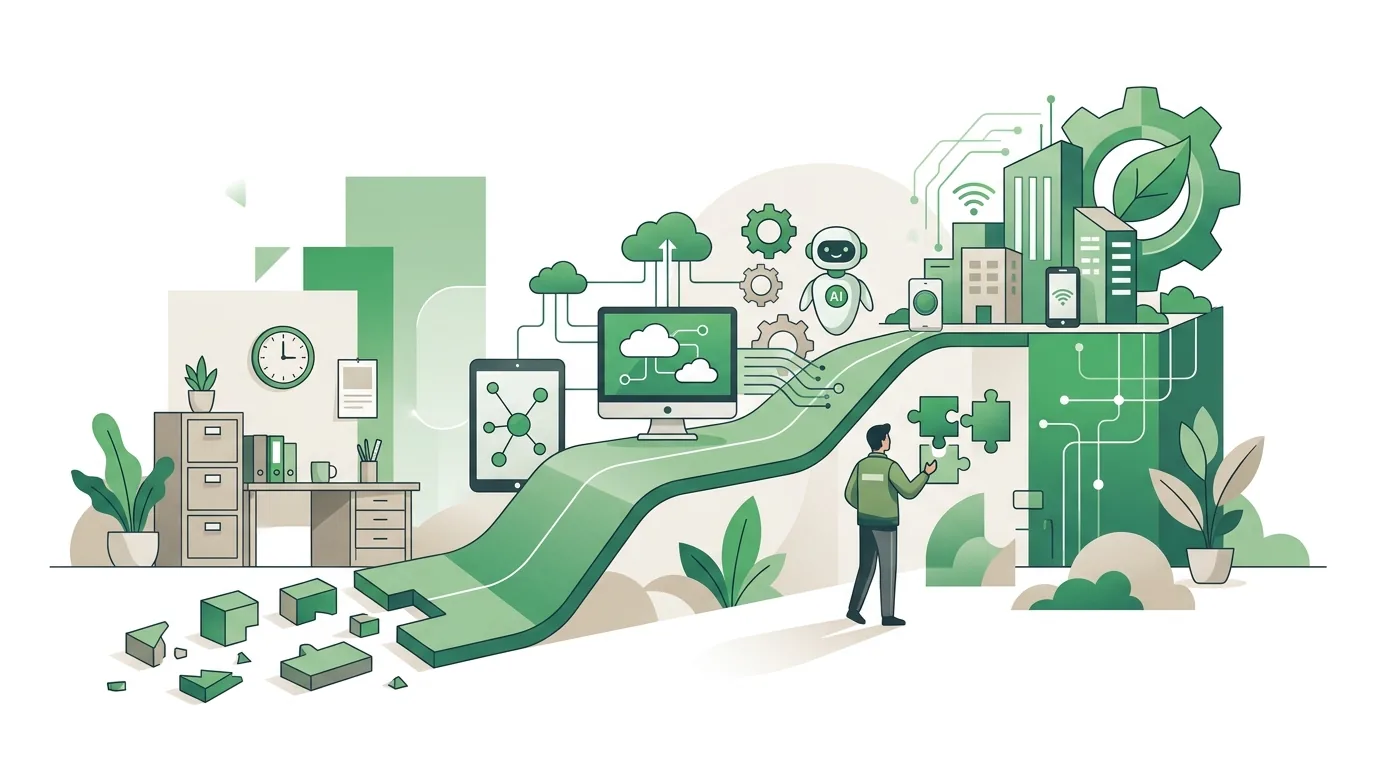
The names of the areas vary from model to model, but the core stays similar. According to Google's AI Overview, which draws on Mittelstand-Digital, standard models analyze several key areas, including strategy (digital goals, leadership, business model, investment) and technology. In practice, the following six areas show up most often. The table shows how you can recognize where you stand in day-to-day operations, not what the ideal looks like.
| Dimension | Typical check question | Evidence you can show |
|---|---|---|
| Strategy | Are there written digital goals with an owner and a budget? | Meeting minutes, an action list with names and deadlines |
| Processes | Does one core workflow run from inquiry to invoice without manual re-entry or switching media? | A process sketch marking every point where data gets retyped |
| Data | Is there exactly one maintained source for customers and products? | Number of parallel lists, duplicates found in a sample |
| Technology | Are systems connected through integrations, or do they just run side by side? | A system map showing data flows and exports |
| Customers and offering | Can customers place orders, book appointments or check status digitally on their own? | Channels that are actually used today |
| People and culture | Who can use the tools, and who improves workflows on their own? | Training status, named key users, backup and coverage rules |
How are digital maturity levels structured?
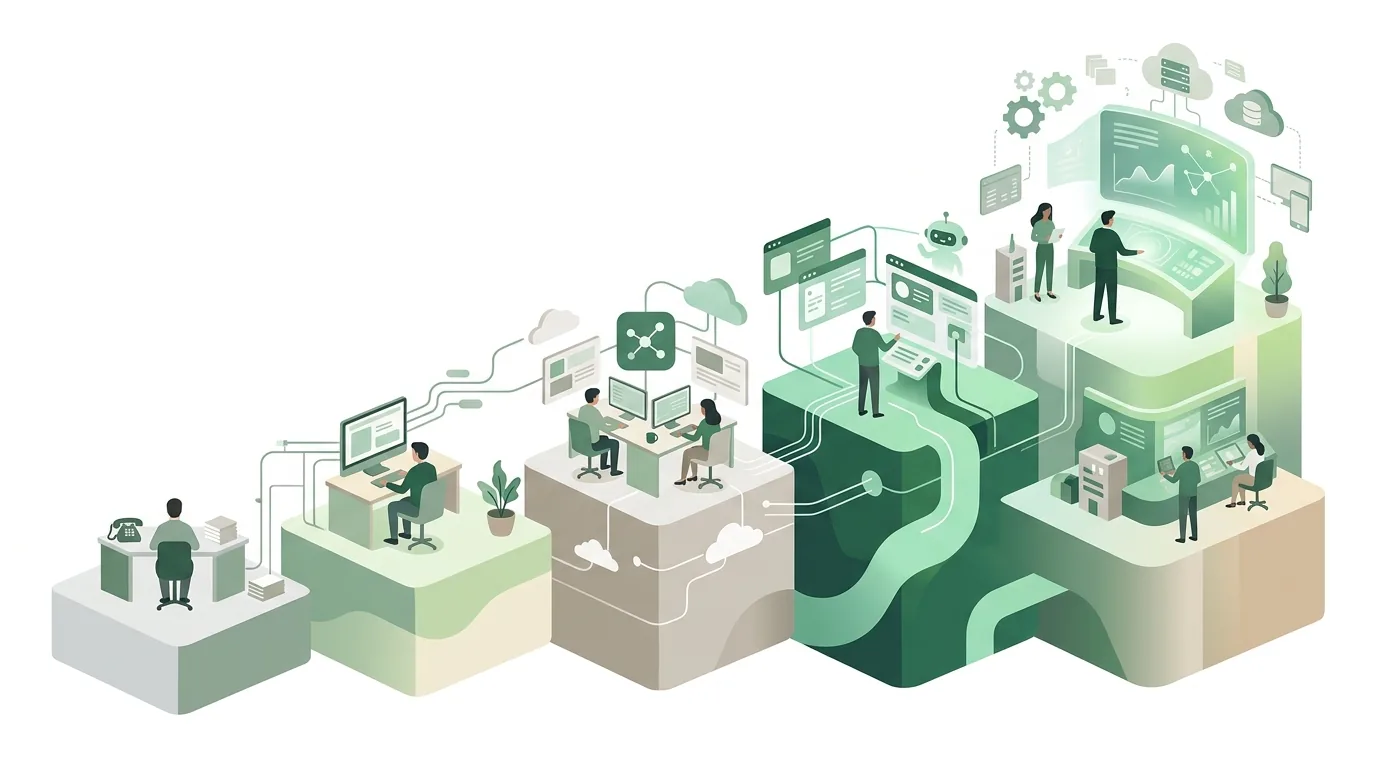
Almost every model places each dimension on a ladder of levels, from "analog or ad hoc" to "data-driven and continuously improving". How many levels there are and what they are called is up to each model. One model from the search results, for example, labels "maturity level 4" the "Digital Leader", ready for digital value creation. There is no common standard for these levels. That is why results from two different models cannot be compared directly.
A typical ladder looks roughly like this. At the bottom, information lives on paper or in scattered files. One level up, there are individual programs with no connection between them. Next, the systems are connected and data flows without anyone retyping it. At the top, you analyze that data and steer the business by it. One rule applies when rating yourself: a level only counts once it is actually lived in daily work. Software that was bought but is barely used does not raise a level. If anything, it shows that something is missing in the people dimension.
How do you run a digital maturity assessment in your own company?
In its publication "Digitaler Reifegrad für KMU" (digital maturity for SMEs), RKW Baden-Württemberg describes a five-step approach that begins with a preliminary conversation with senior management. Whichever model you choose, the following sequence has proven itself.
- Define the purpose: What do you need the result for? An investment decision, a grant application, or deciding the order of projects? The purpose determines how precisely you need to measure.
- Pick a model and stick with it: Use the same model for the first assessment and every one after. Switch models and you lose comparability.
- Gather several perspectives: Management, department heads and people from day-to-day operations rate separately. Large gaps between them are a finding in their own right.
- Back up every level with evidence: Every rating needs proof, such as a process sketch, a list of systems or a sample from your data.
- Analyze the profile, not the average: Mark the weakest dimension in the workflow that matters most for revenue.
- Derive actions and schedule the next assessment: Every bottleneck gets an action with a named owner.
For step 4, a structured process analysis with wait times and cycle times works well. It produces the evidence for the processes dimension almost as a by-product.
Example: digital maturity of a trade business
A made-up example, not a client case: an electrical contractor with an office and several field crews assesses itself. In strategy, there is a goal ("paperless job management") but nobody responsible for it: lower level. In technology, there is field service software for tradespeople, an accounting program and a well-maintained website, but jobs move from one system to the next via exports: middle level. Customer data sits in the software, in the email client and on notes in the trucks: lower level. And in processes, the electricians write their hours on paper, and the office types them in.
The average would land somewhere in the middle and suggest a little fine-tuning everywhere. The profile shows something else. The bottleneck is the break between job site and office, and it hinges on how data is kept. So the sensible first step is neither a new website nor an AI project. It is mobile time tracking that writes directly into the existing software, preceded by a cleaned-up customer database. How to derive the first step from a finding like this is covered in the article small business digitalization: where to start.
What types of digital maturity models are there?
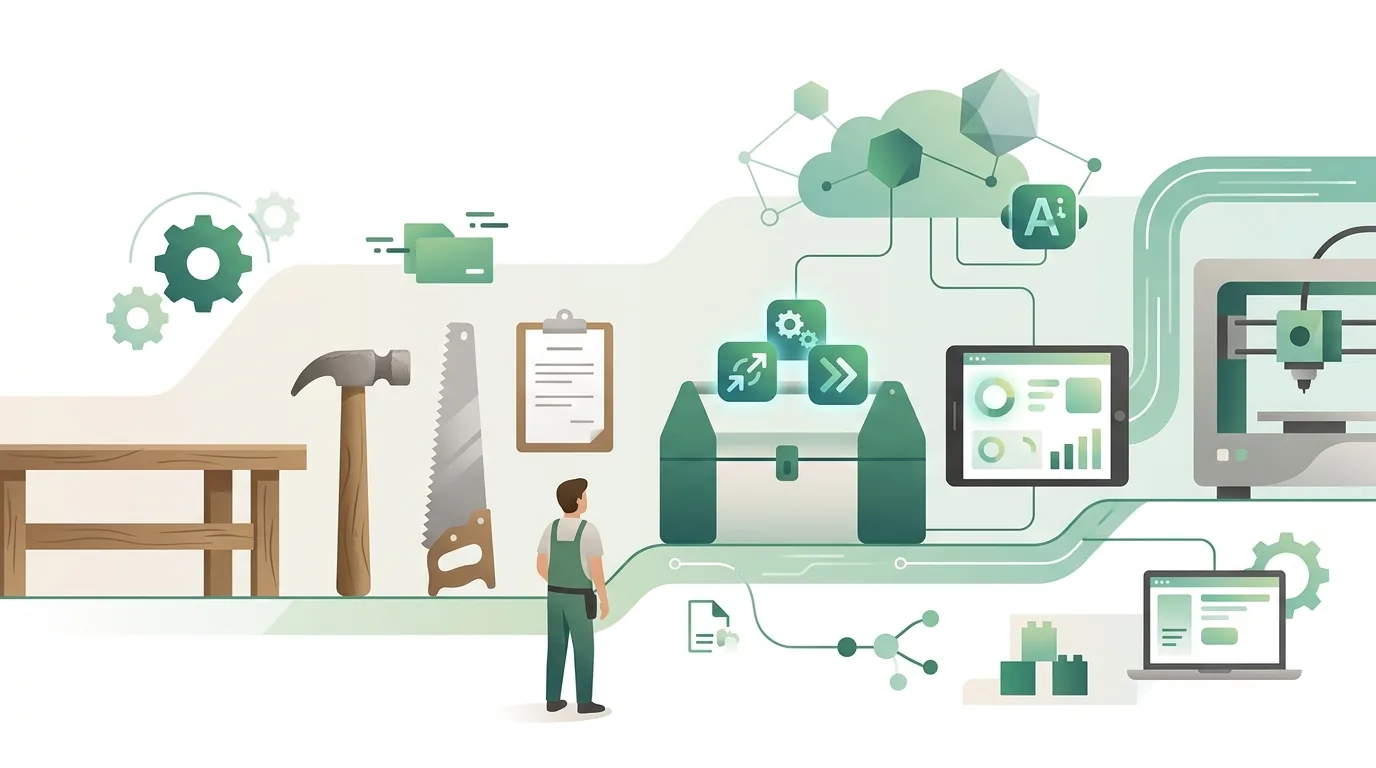
Models differ mainly in how the result is produced and who they were built for. Among the sources Google's AI Overview cites are, for example, a guide from Bitkom, the German digital industry association, on a maturity model for digital business processes, the digital maturity assessment by Fraunhofer SCS, and the maturity model for Germany's Online Access Act (Onlinezugangsgesetz). The latter rates public administration services, not companies. There are also academic models for individual sectors, such as a maturity model for digital transformation in nonprofit organizations published by Springer. The table compares the types against the same criteria.
| Type | How the result is produced | Good fit for | Limitation |
|---|---|---|---|
| Online self-assessment | Questionnaire, automated scoring | A first overview, a starting point for discussion | Self-rating without evidence, tends to come out too positive |
| Guided assessment with interviews | Conversations with several roles, on-site walkthrough, evaluation by a third party | Investment and prioritization decisions | Time spent on meetings and preparation |
| Process-based model | Rates individual business processes instead of the whole company | Businesses with clearly defined core workflows | Strategy and culture are partly left out |
| Sector or academic model | Dimensions developed through research or for one industry | Organizations with their own framework, such as nonprofits or public administration | Transfers to other industries only to a limited extent |
Common digital maturity assessment mistakes
- The score becomes the goal: To reach a higher level, companies buy software instead of changing a workflow. The score goes up, daily work stays the same.
- Only management does the rating: The view from the top usually differs from the view from the warehouse or the phones. Without voices from day-to-day operations, the manual handoffs stay invisible.
- Counting tools instead of checking usage: Lots of programs do not add up to maturity if data still gets copied between them by hand.
- Measuring once and filing it away: Without repeating the assessment with the same model, you cannot tell whether your actions had any effect.
- The model does not fit the industry: A model built for connected manufacturing rates a retailer on criteria that do not matter to them.
When an elaborate assessment is not worth it: in very small businesses whose bottleneck is obvious anyway. If everyone knows invoices are being typed twice, a week of analysis is a worse investment than one day spent fixing the problem. The priorities that apply in retail are summarized in the article digital transformation in retail: steps and limits.
Is AI literacy part of digital maturity?
If you use AI systems, you should expand the people dimension to include AI literacy, because there is a legal obligation behind it. Under Article 4 of the EU AI Act, in its amended version currently in force (following amending Regulation (EU) 2026/1744, applicable since July 27, 2026), providers and deployers of AI systems take measures to support the development of AI literacy among their staff and other persons dealing with the operation and use of AI systems on their behalf. They are not required to guarantee a specific level of AI literacy for any individual. The text of the regulation is available on EUR-Lex. For your maturity assessment, this means: record which AI tools are in use, who uses them, and what training or instructions exist. That is an inventory, not a statement about whether your business complies with the regulation.
What comes after the assessment
A maturity result is only worth something once it turns into an action with an owner. Often a short list is enough: bottleneck, action, who, by when, and how you will know it is working. This is exactly where DigifyNow comes in. In digitalization consulting from DigifyNow, we use the finding to determine which workflow goes first. Then we decide whether off-the-shelf software, an automation or a custom solution is the right fit. The implementation, from web apps and AI assistants to training your staff, is described on the page covering the services of DigifyNow. If the finding shows that the data foundation needs cleaning up first, we say so, even if that means no software project for now.
When outside help is worth it
Outside help pays off when management and staff rate things very differently, when several bottlenecks compete for the same budget, or when the result is supposed to lead to a software investment. Have the following ready: a list of the systems you use, a rough sketch of your most important workflow from inquiry to invoice and, if you have one, the result of a self-assessment. In a free, no-obligation assessment of your project, we look together at which bottleneck should come first.
Frequently asked questions
What is the difference between digital maturity and digital transformation?
Digital maturity measures the current state, meaning how far processes, data, technology and culture are digitized today. Digital transformation describes the path and the goal, meaning where the company wants to go and why. Maturity is therefore a snapshot. Transformation is an initiative you can track across several assessments.
How often should you assess digital maturity?
There is no fixed rule. It makes sense to repeat the assessment once the actions from the last one have been implemented, using the same model and the same roles. If you switch models, you cannot compare the results, because every model defines its levels and dimensions differently.
Is a free online self-assessment enough?
For a first overview, yes. But a self-assessment relies on self-rating without evidence and therefore often comes out too positive. Before an investment decision, check every rating against evidence, such as a process sketch or a data sample, and have several roles rate separately.
Which dimension should you improve first?
Not necessarily the one with the lowest score, but the weakest dimension in your most important workflow. If the bottleneck is, for example, customer data maintained in two places, new software will do little as long as the data foundation has not been cleaned up. An overall average across all dimensions hides this connection.