Small Business Digitalization: Where to Start
· DigifyNow
Small business digitalization works when you start not with software but with the one process that costs you the most time, follow-up questions or errors today. There, data gets entered only once, the gaps between paper, Excel and email disappear, and systems are connected through interfaces (APIs). Only then do you pick the tool: off-the-shelf software for standard industry processes, low-code for simple forms, and custom development only where your process sets you apart from competitors.
What does small business digitalization actually mean?
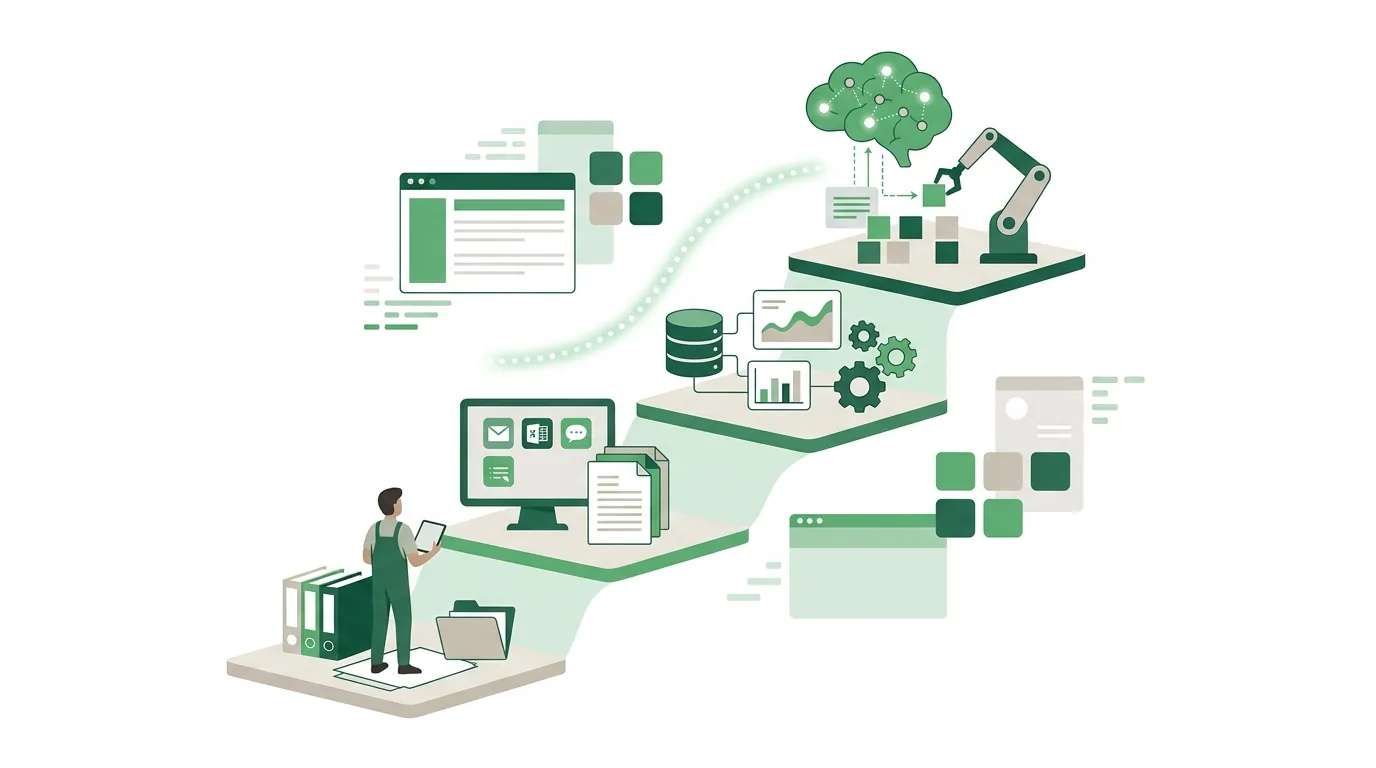
Small business digitalization happens on three levels, and people often lump them together. On the first level, information is captured digitally: an order no longer arrives as a fax but as a data record. On the second level, processes get connected. That same record then moves from quote to order to delivery note to invoice without anyone retyping it. On the third level, what you offer changes, for example through a customer portal or a digital service. Most companies have come a long way on the first level and are stuck on the second. For what this looks like in practice, see our article with digitalization examples from small businesses in sales, accounting and customer service.
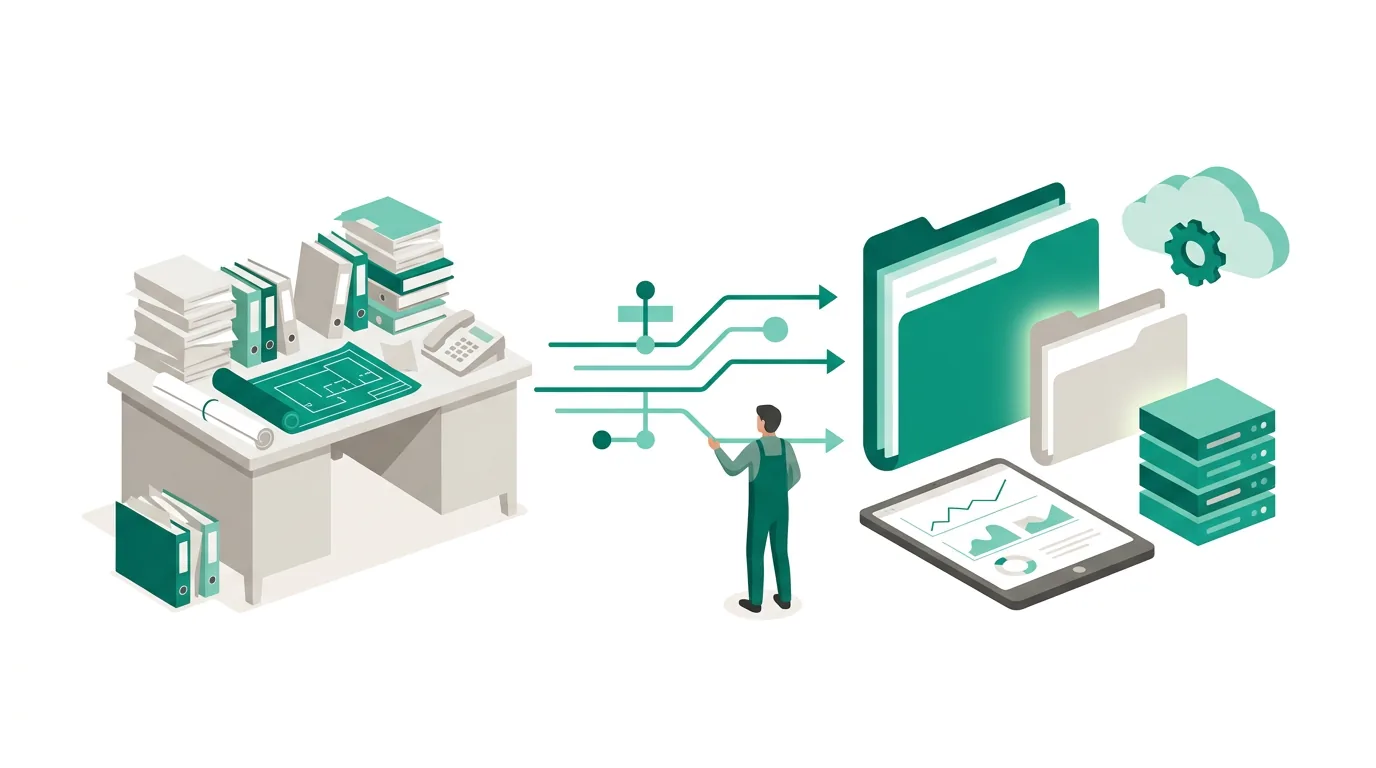
How to spot the problem: look for a break between media or systems. Someone reads information off one system and types it into another, prints out an email, or keeps an Excel list running alongside the software. Every one of these spots is a source of errors and triggers follow-up questions. So you digitalize by eliminating these spots one by one, not by buying new programs.
Where do small and midsize businesses stand on digitalization?
Reliable numbers on how far small and midsize companies in Germany have come come from public sources. The Federal Network Agency (Bundesnetzagentur) publishes key figures on digitalization levels, AI use and the promotion of AI literacy, each broken down by company size class (number of employees). KfW Research and the Institut für Mittelstandsforschung (IfM) Bonn have their own topic pages on digitalization. What is most useful for your company is the pattern running through these analyses: the smaller the business, the less often it uses advanced technology and the more often it lacks a plan of its own for digitalization.
We see the reasons for this again and again in our project work. There is no IT department, so every digital topic lands on the owner's desk or with a tech-savvy employee who handles it on the side. Legacy industry software is hard to connect because it has no open interface. And day-to-day business always comes first, so a project without a clear owner and a clear end date fizzles out. Comparing yourself with averages therefore won't get you very far. The more useful question is which process in your company causes the most duplicate work.
In what order should you digitalize a small or midsize business?
The order matters more than the choice of tool. If you roll out software first and adjust the processes afterwards, you usually just rebuild the old detour in digital form. Here is how to go about it:
- Make your processes visible: Capture on a process landscape map which core and support processes exist and who is involved. One page is enough.
- Pick the bottleneck: Choose a single process where waiting time, follow-up questions or errors are most obvious, for example the path from quote to order, or incoming invoices.
- Document the current process: Write down every step with its role, system and handoff. Mark every spot where data is retyped or printed out as a media break.
- Clean up your master data: Customers, items and prices need one single source of truth. If customers exist twice in two systems, digitalization just doubles the errors.
- Choose the tool: Check off-the-shelf software first, then low-code, and only then custom development, and look at interfaces and data export every time.
- Start small: Test the new process with one team and real cases. Decide beforehand how you will measure success, and fix the problems before you expand.
- Train and roll out: If the Excel list keeps running alongside the new system, the system hasn't been adopted. Set the date after which the old list no longer counts.
The first three steps have their own guides: the process landscape map with layout and example, and the approach to digitize business processes with required fields and status values. If data has to move, our article on data migration includes a checklist with a test run.
Off-the-shelf software, low-code or custom development?
There is no one-size-fits-all answer here. But the three paths can be measured against the same criteria. The table compares approaches, not individual vendors.
| Criterion | Off-the-shelf software (SaaS or licensed) | Low-code and automation platforms | Custom development |
|---|---|---|---|
| A good fit when | the process is standard for your industry, such as accounting, payroll or inventory management | you need simple forms, approvals or data handoffs between existing systems | the process is what sets you apart, or no standard solution covers it |
| Who handles operation and updates | the vendor | the platform vendor for the runtime, you for your own logic | you or a contracted service provider |
| Customizability | limited to the vendor's settings and extensions | within the platform's building blocks | complete |
| Typical limit | you adapt your process to the software | the application only runs on the vendor's platform; licenses are often charged per user | maintenance, security updates and documentation stay with you permanently |
| Data when you switch | depends on the vendor's export functions | depends on the platform | sits in your own database |
For data handoffs between systems, many businesses use automation tools: n8n can also be self-hosted (see the n8n documentation), while Zapier runs as a hosted service. Both hit their limits when a target system has no interface, because then there is nothing for a workflow to connect to. For the trade-offs in detail, read our articles on custom software vs. SaaS and on when low-code is enough.
What role does AI play in small business digitalization?
AI builds on digitalized processes; it doesn't replace them. An AI assistant can pre-sort emails or draft quotes, but only if customer and item data are clean and accessible. If the knowledge lives only in people's heads and paper binders, the assistant fails. That's why AI comes after master data and the first connected process in the sequence. Practical examples with a review step and their limits are in our article on AI for small business.
If you use AI in the EU, the European AI Act applies to you. In its current, amended version, it requires providers and deployers of AI systems to take measures that support the development of AI literacy among their staff and other people who work with AI systems on their behalf. They do not have to guarantee any particular level of literacy. In practice, that means training, written usage rules and a point of contact for questions. The Act's transparency obligations already apply; the rules for high-risk systems take effect later, staggered by type of system. Whether your use falls under them depends on the specific system and its purpose. When in doubt, have it reviewed by a legal professional.
Why do digitalization projects fail in small and midsize businesses?
- Everything at once: When several processes are switched over in parallel, nobody feels truly responsible for any of them. The cause: there is no priority based on the bottleneck.
- Software before process: The new system reproduces the old detours because nobody checked which steps could be dropped.
- Duplicate data: The Excel list keeps running because the system is missing a field. After a few weeks, the two data sets no longer match.
- No interface: The industry software doesn't allow data exchange. That leaves only file exports, screen automation or switching systems.
- No data export agreed: When you change vendors, you only get your data out partially because the contract doesn't cover it.
- Training as a one-off: Without a point of contact in daily work, employees go back to paper and phone at the first problem.
Digitalization doesn't pay off where a process rarely occurs and is handled by just one person. A task that comes up once a quarter doesn't justify its own software; a clean template is enough. Retail has its own sequence, starting with the point of sale and the item master, described in our article on digital transformation in retail.
What does digitalization cost, and what funding is available?
There is no flat figure, because the cost depends on four factors. First, scope: how many processes, roles and special cases there are. Second, interfaces: how many systems need to exchange data and whether they have open APIs. Third, data: whether legacy records need to be cleaned up and transferred. Fourth, operation, because per-user licenses, hosting, maintenance and security updates come up again every year. A binding number only exists once the scope is described in writing. How a fixed price differs from time-and-materials billing is explained in our article on software development cost.
Funding programs change frequently. The German federal program "Digital Jetzt" is now described in the past tense on its program page. So before any planning, check whether a program is still accepting applications and whether you're allowed to award contracts before approval, because many guidelines rule that out. A publicly funded first point of contact in Germany is the centers in the Mittelstand-Digital network, which provide information and support companies locally. A map shows you which center covers your region.
Digitalization in Koblenz: who can help locally?
Companies in and around Koblenz have two kinds of places to turn. The publicly funded centers in the Mittelstand-Digital network offer information, workshops and an initial assessment. The network's map shows which center is responsible. Developing or implementing software is not part of their remit. For implementation, you need a service provider who documents the processes, connects the systems and takes over operation. DigifyNow is based in Unnau in the Westerwald region and works with businesses in Koblenz, the Westerwald and the Siegerland, on site if you prefer. What the team offers there is on our page about digitalization and software development in Koblenz.
How DigifyNow approaches digitalization
DigifyNow builds custom software, web apps and apps for small and midsize businesses and introduces AI, with assistants, automation and employee training. A project starts by documenting the bottleneck process. From that we build an MVP that contains only the core function and, according to our service description, is usually in use after 4 to 8 weeks. After that, it is expanded while in operation. If off-the-shelf software covers the process, we tell you so instead of building something of our own. How we work with you to sort out processes and systems is described on our page on digitalization consulting. All our services, from app development to AI adoption, are in our services overview.
When outside help is worth it
Outside help pays off when a process connects several systems without open interfaces, when legacy data has to be migrated, or when nobody in-house has the time to see a project through to the end. You don't need it for a single template or a tool you can set up yourself. Ideally, bring the following to the conversation: the process that slows you down the most, the programs involved, the approximate number of users and, if available, sample documents. In a free, no-obligation assessment of your project, we discuss which path fits and what the cost drivers are.
Frequently asked questions
What counts as a small or midsize business (Mittelstand)?
There are two common definitions. The European Commission defines small and medium-sized enterprises by headcount, revenue and balance sheet total. The IfM Bonn adds a qualitative criterion: ownership and management in the same hands. So under the IfM's understanding, a family business can belong to the Mittelstand even though it is too large for the EU definition. For funding programs, the definition in the respective funding guideline applies.
Does a small business need its own digitalization strategy?
You don't need a lengthy strategy document, but you do need a written priority covering three points: which process gets switched over first, which system is the source of truth for customer, item and price data, and who is responsible. Without these decisions, you end up with tools side by side that don't exchange data. With them, you can check every new piece of software against whether it fits your leading data source.
How long does it take to digitalize a process?
That depends on the interfaces and the state of your data, not on the size of the company. Off-the-shelf software without data migration is rolled out faster than custom development with three connected systems. At DigifyNow, an MVP with the core function is, according to our service description, usually in use after 4 to 8 weeks. For a specific project, that is not a commitment but a framework for planning.
Is digitalization the same as digital transformation for small business?
No. Digitalization maps existing processes digitally and connects them, for example the invoice as a data record instead of on paper. Digital transformation, on the other hand, changes the business model itself, for example through a customer portal or a new digital service. Most small and midsize businesses should digitalize first, because transformation requires clean, connected data.