AI Costs: Seats, Tokens, Agents and Operations
· DigifyNow
AI costs a business money in three ways: a per-user subscription for chat tools, usage billed per token through the API, and the effort of integration, operations and training. Usage depends on context length, model size and the number of model calls, and AI agents call the model several times per task. To keep costs in check, set spending limits in the provider account, use the smallest model that handles the task, and measure cost per completed transaction.
How much does AI cost a business? The four cost blocks
AI costs for a business fall into four blocks: a per-user subscription for chat tools, usage billed per token when software calls the model through the API, a one-time effort to connect AI to your own systems, and ongoing costs for operations and training. Whether it ends up cheap or expensive depends less on the list price per token than on how many model calls each transaction triggers and how much text gets sent along with every call. When people ask how much AI costs, they usually mean the monthly price of a chat tool, and that's often not the biggest line item. Each block is billed differently and grows for a different reason. We deliberately don't quote dollar amounts here: providers change their list prices often, and what a specific project costs depends on scope, integrations and the state of your data.
| Cost block | How it's billed | What drives the amount | Common misconception |
|---|---|---|---|
| Chat tool subscription | Fixed amount per user per month, sometimes with usage caps | Number of seats, plan tier, features such as admin controls and single sign-on | "The subscription covers automated workflows too." In reality, API access is usually a separate account, billed separately. |
| API usage | Per token, with input and output priced separately | Model, length of the input including documents, length of the response, number of calls | "Every request costs the same." In reality, long context and agent loops multiply usage. |
| Integration and development | One-time project effort | Number and quality of integrations, data preparation, permissions, testing | "The model is the expensive part." Data access and error handling often take more work. |
| Operations and training | Ongoing: hosting, monitoring, maintenance, training | Providers switching models, API changes, staff turnover | "Once it's live, there's nothing more to pay." In reality, providers retire older models and prompts have to be updated. |
How project effort for software breaks down in general is covered in our article on what drives software development cost. The same principle applies to AI, with a usage-based component added on top.
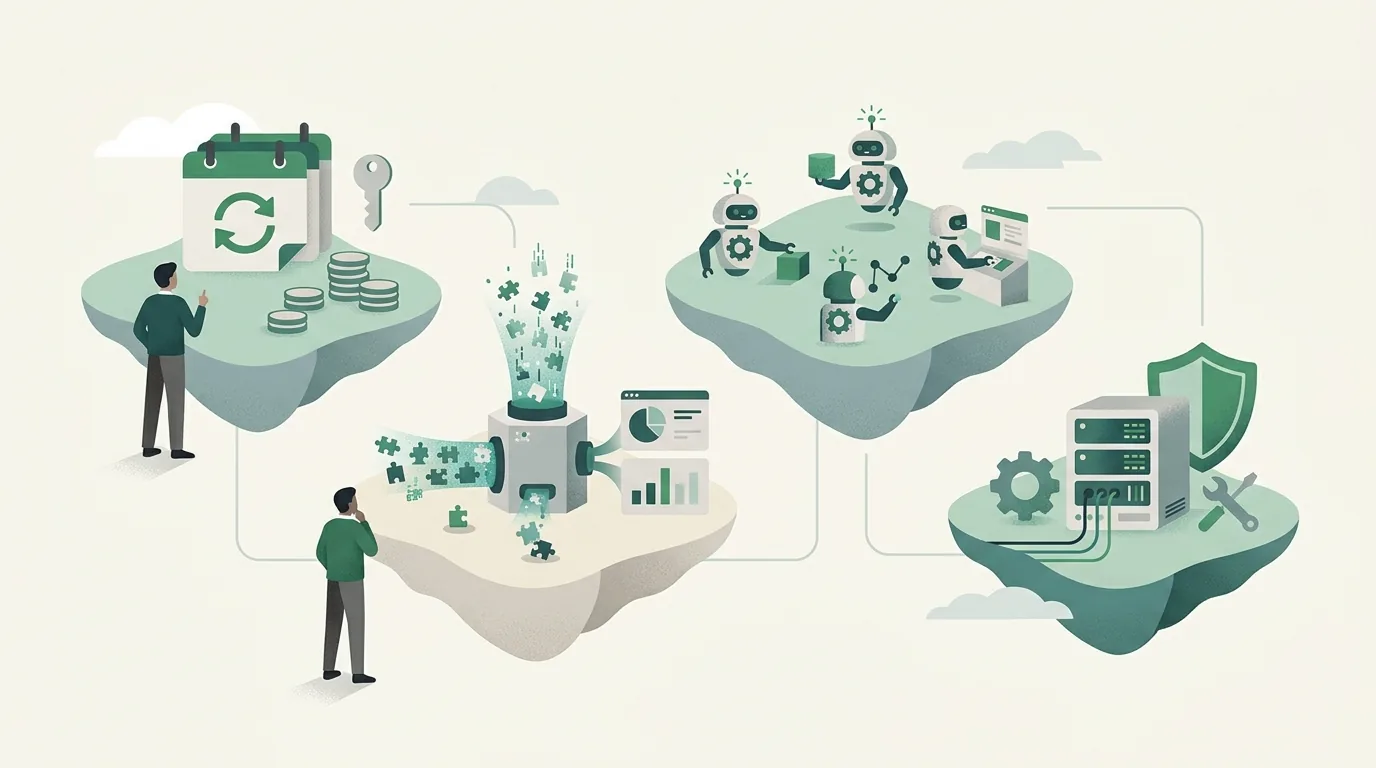
How do AI providers charge: per user or per token?
There are two basic models. With a subscription, the business pays per person per month, no matter how much anyone actually uses the tool. That's easy to budget, but it gets expensive when many seats sit mostly unused. With the API, you pay per token. A token is a piece of a word, the unit in which the model reads and writes text. Input tokens (the question, instructions, attached documents) and output tokens (the response) are priced separately. Providers publish current per-model pricing in their developer documentation, for example OpenAI at developers.openai.com and Anthropic at docs.anthropic.com.
In between there are hybrids: subscriptions with usage caps that throttle heavy users, flat fees for the whole organization, or prepaid credit models. For your budget, this means a subscription tool costs per user, while an AI feature built into your software costs per transaction. Lump both into one bucket and you can't manage either of them.
Do you have to pay for AI?
Not to get started. The major chat tools have free tiers, but they limit messages, models and features. For a company, the real question is a different one, namely the terms: on consumer tiers, the terms of service govern what happens to the data you enter, and providers generally offer a data processing agreement only on business and enterprise plans or for the API. What that means legally in a given case is something every company has to assess for itself. That's why free tiers are usually not an option for internal data. We compared a selection of common tools by data flow and integrations in our article on AI tools for business.
How much does ChatGPT cost?
ChatGPT comes in several tiers: free, a subscription for individuals, and plans for teams and enterprises with user management. The subscriptions are billed per user per month. Separate from that is the OpenAI API, which software uses to call the model. It runs through its own account and is billed per token. So a ChatGPT subscription does not include any allowance for an application of your own. Current prices are listed on OpenAI's pricing page. We don't quote them here because they change regularly.
Why do AI costs keep rising even though tokens get cheaper?
The price per token is one thing, the volume is another, and volume grows for three reasons. First, reasoning models think internally before they answer: according to their developer documentation, OpenAI and Anthropic bill these reasoning steps as output tokens, even though they don't appear in the result. Second, every call resends the entire context, meaning the conversation history, the system instructions and the documents. A chat with a long history gets more expensive with every message. Third, agents turn one task into many calls. German tech outlet heise online reported that large companies are blocking access to AI tools or recommending older models because of rising spend, and tagesschau.de describes AI as a growing cost factor for businesses (both reports accessed in October 2026).
The takeaway: if you extrapolate your costs from a test with a handful of sample requests, you'll usually be off once the system is in production. Real transactions are longer, come with attachments and trigger follow-up questions. Base your estimate on samples from real day-to-day work, not on demo questions.
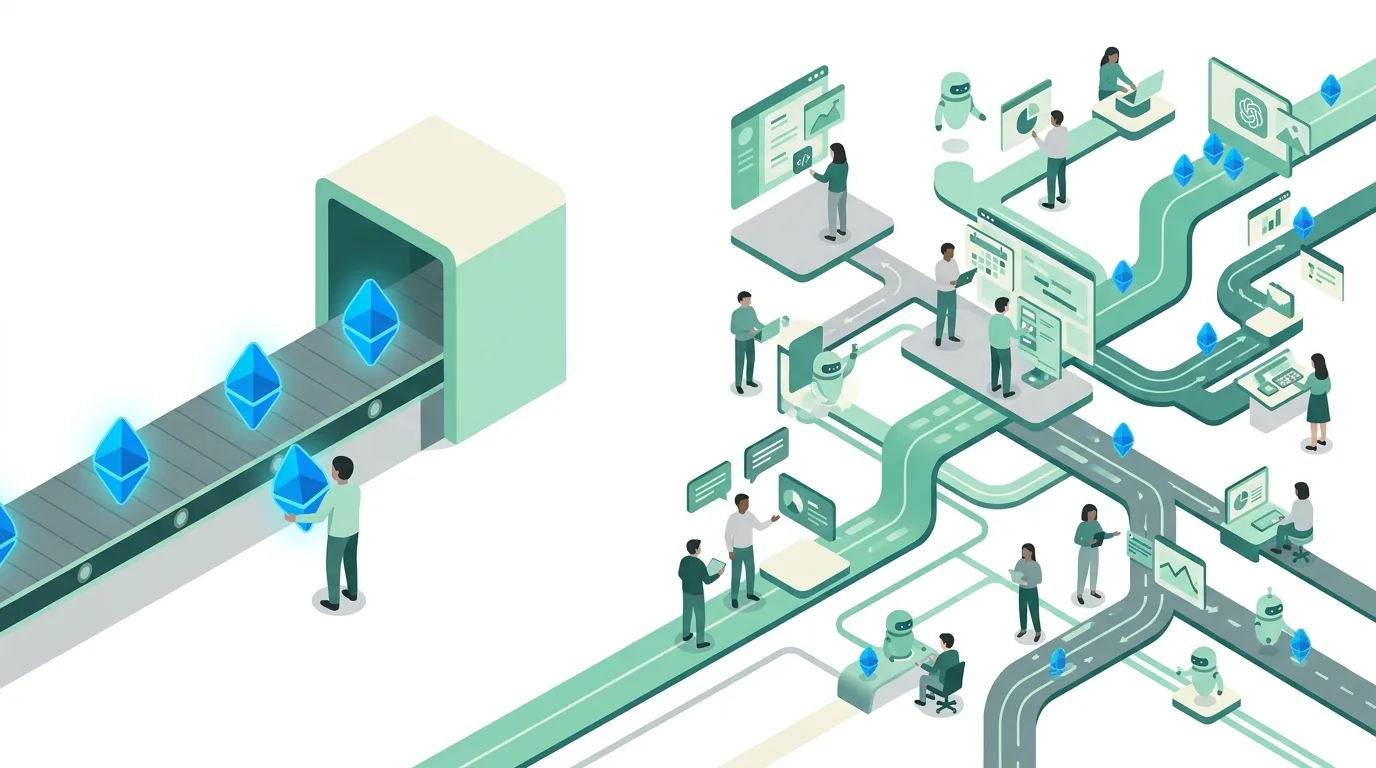
How do you calculate AI cost per transaction?
A reliable estimate doesn't come from the price per token alone, but from a calculation per transaction. Here's how we approach it, without any dollar figures, which only get plugged in from the current price list of the model you choose:
- Define the transaction: what counts as one unit? An incoming invoice, a support request, a draft quote.
- Collect a sample of real transactions from everyday work, including attachments and long emails, not just the clean cases.
- Count the model calls per transaction: a simple extraction takes one call, an agent that looks up the order, checks the status and drafts a reply takes several.
- Measure tokens per call, split into input and output. The API reports these numbers with every response, so you don't have to guess.
- Multiply by the model's current prices: transactions per month times calls per transaction times tokens per call.
- Add the fixed costs alongside: hosting, monitoring, maintenance and subscriptions that apply regardless of volume.
- Factor in rework: how often does a person have to correct the output? A cheap model that needs a lot of corrections isn't cheap per completed transaction.
An example of how the math plays out: for invoice intake, a single call per document can be enough if the model only extracts fields and a fixed rule handles the matching. If you instead let an agent look up the supplier, the purchase order and the discrepancy on its own, one call quickly becomes several, each carrying the growing history. Same task, but usage per document is a multiple of the original.
AI agents: how they work and what they cost
What is an AI agent?
An AI agent is a language model that doesn't just answer but decides on its own which tool to call next: a CRM search, pulling up an order, an email draft. The software wrapped around the model executes the call and returns the result, until the task is done or a limit kicks in. Tools are often connected today via the Model Context Protocol, whose specification is published at modelcontextprotocol.io. How these servers are put together is explained in our article on MCP servers.
How does an AI agent work, and why does it cost more?
- The model receives the task, the system instructions and the descriptions of every available tool. Those descriptions alone count as input tokens on every call.
- The model picks a tool and the parameters for it. That's a call that produces output tokens.
- The software runs the tool. The result, say a customer list, goes back into the model as new input.
- Every further step resends the entire history so far. With many steps, usage grows with each one.
- Without a loop limit, an agent stuck on an error can call the same tool over and over, running up costs without making progress.
AI agent examples and what drives their cost
- Drafting a quote from a customer inquiry: the model reads the inquiry, looks up products and terms, and writes a draft. The cost driver is long product lists sent along as context.
- Pre-sorting incoming invoices: the model extracts data from documents, matches suppliers and flags discrepancies. The cost driver is scanned PDFs, whose images consume a lot of input tokens.
- Answering support requests with access to the knowledge base: the cost driver is the search results loaded into the context for each request.
- Research across multiple sources: the cost driver is the number of search and reading steps, which the model decides on its own.
AI agent example: a support request step by step
A customer writes that their delivery was incomplete. The agent receives the email and first calls the order lookup tool, with the customer number as a parameter. The order data comes back and goes into the model as new input. In the second step, the agent checks the shipping status in the logistics system. In the third, it searches the knowledge base for the rule on partial shipments. Only on the fourth call does it write the draft reply, which a staff member approves. That's four model calls for one request, and each one includes the email, the tool descriptions and all results so far. What goes wrong: if the order lookup returns nothing because the customer number is missing from the email, an agent without limits keeps trying other search terms until the loop limit kicks in. That's why every agent needs a maximum number of steps and a handoff to a person when data is missing.
The cases are covered in more detail, with approval levels and failure patterns, in our AI agent examples for small and midsize businesses.
Building AI agents: what drives the effort
What makes development expensive is rarely the model itself, but everything around it: clean integrations with your own systems, permissions that let the agent only read or only create drafts, human approval before anything gets sent, logs of every tool call, and testing with real cases. If a system has no API, one has to be built or the system replaced. The steps from scoping the task to setting the loop limit are covered in our article on how to build an AI agent. Where a fixed workflow with clear rules is enough, regular automation without an agent is often cheaper to run, because it only calls the model where text genuinely needs to be understood.
Cloud AI or local AI: when does self-hosting pay off?
Open models can run on your own hardware or on rented GPU servers. Then there are no token fees, but you pay for hardware, power, setup, updates and someone to monitor operations. Those costs keep running even when nobody sends a request. Self-hosting mainly makes sense when the load is consistently high or when data shouldn't leave the building. With occasional or fluctuating use, you're mostly paying for idle time. On top of that, there's a performance ceiling: models that run on affordable hardware are usually smaller than the big cloud models and hit their limits sooner on complex tasks. So before you price out hardware, test with real cases whether the local model can handle the task at all. The hardware you'd need is covered in our article on how to run AI locally.
The same trade-off applies one level up, for automation: according to its documentation at docs.n8n.io, n8n can be self-hosted. That partly eliminates license or execution fees, but you carry the servers and the maintenance yourself.
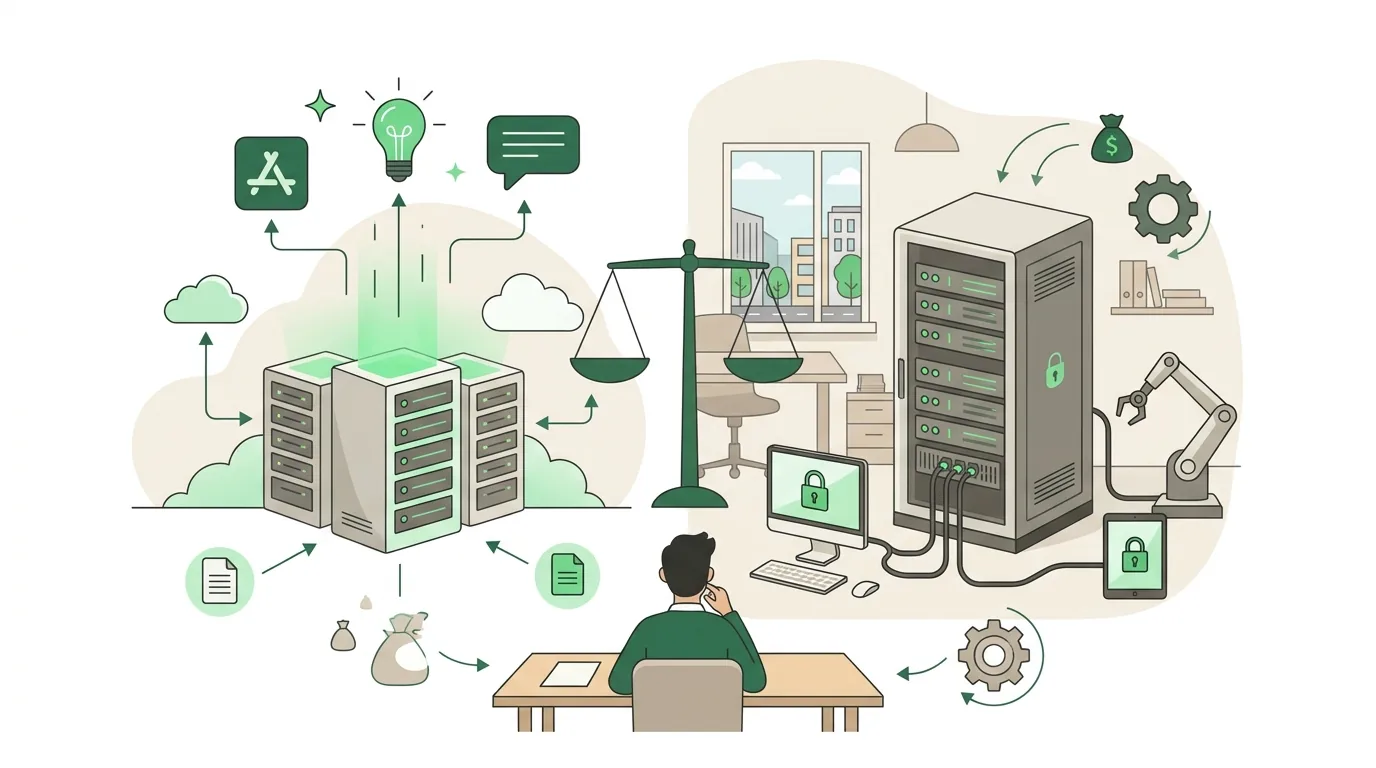
How can you keep AI costs under control?
- Set spending limits in the provider account, separately for each project or application. That way, a bug in one application stays confined to its own budget.
- Pick the smallest model that reliably handles the task in testing. For classification or extraction, a small model is often enough; for multi-step reasoning, it isn't.
- Trim the context: send only the relevant document sections instead of entire manuals, and summarize old chat histories instead of dragging them along in full.
- Use prompt caching where the provider offers it. Parts that stay the same, like system instructions, are then billed at a lower rate.
- Measure cost per transaction rather than per month: only then can you see whether a workflow is worth the money.
- What doesn't work: buying seats for everyone and hoping people use them. Unused seats cost money month after month without anyone noticing.
An often-forgotten line item is training. Under Article 4 of the EU AI Act, in its current amended version, providers and deployers of AI systems take measures to support the development of AI literacy among their staff and other people working with AI systems on their behalf. They are not required to guarantee any particular level of competence. For your budget, that means time for training and ongoing support belongs in the plan. DigifyNow offers AI coaching for teams for exactly this.
How DigifyNow estimates AI projects
DigifyNow, based in Unnau in Germany's Westerwald region, builds AI assistants and automated workflows for small and midsize businesses. Before we name a number, we pin down the cost drivers: which systems need to be connected, whether they have an API, how many transactions come in per month, how long the inputs are and who will run the system. From that, we estimate what usage costs per transaction, separately from the one-time development effort. How we set up a custom AI assistant for businesses and how AI workflow automation works with us is described on the respective service pages. Sometimes the conclusion is that a standard subscription is enough and no custom development is needed. When that's the case, we say so.
When outside help is worth it
Outside help pays off when AI needs to connect to your own systems such as ERP, CRM or document storage, when an agent is supposed to trigger actions on its own, or when ongoing costs are hard to estimate because volumes and input lengths fluctuate. For plain chat use with a standard subscription, you usually don't need it. Have these ready: a description of the workflow, a few real sample transactions, the systems involved and whether they have an API, and the approximate monthly volume. With that, you can request a free, no-obligation assessment of your AI project from us. It isn't a quote and not a binding commitment on price or timeline.
Frequently asked questions
How much does AI cost a business?
The costs come from four blocks: a per-user monthly subscription for chat tools, per-token usage for API calls, a one-time effort to connect AI to your ERP, CRM or document storage, and ongoing costs for operations and training. Usage works out to transactions per month times model calls per transaction times tokens per call. That's why there's no fixed total.
Is AI expensive?
It depends on how you use it. A chat subscription costs a fixed amount per user per month and is easy to budget. AI usually gets expensive through usage: long context, reasoning models and agents with many steps multiply the tokens per transaction. On top of that come one-time integration costs and ongoing costs for operations and training.
Do you have to pay for AI?
Not to get started: ChatGPT, Claude and others have free tiers with limited messages and features. In a business, though, what matters is what happens to the data you enter. Providers generally offer a data processing agreement only on business and enterprise plans or for the API. Whether that's sufficient is something every company has to assess legally for itself.
Which AI is the cheapest?
Per token, small models are cheaper than large ones, and reasoning models are the most expensive because their thinking steps count as output. But cheap doesn't mean low-cost per transaction: a small model that frequently gets a task wrong creates rework. So compare the cost per successfully completed transaction, using real test cases from your day-to-day work.
What does an AI agent cost to run?
It works out to transactions per month times model calls per transaction times tokens per call, plus hosting and maintenance. Unlike a simple request, an agent resends the entire history so far at every step, so costs grow with each step. A loop limit and a spending limit in the provider account keep outliers in check.