Make Money With Apps: Models and Limits
· DigifyNow
Apps that pay users pass on only part of what third parties pay: market researchers pay for opinions, advertisers for attention, retailers for purchases. Usually that adds up to pocket money, paid out only after a minimum balance. A business makes money with its own app through the purchase price, in-app purchases, subscriptions, ads, or selling goods and services. On Apple and Google, digital content generally has to go through their billing system, and the stores keep a commission.
Make money with apps: What people actually mean
The short answer: there are two ways to make money with an app. As a user, you get a small share of what market researchers, retailers or advertisers pay the app. That usually amounts to pocket money, and it's paid out only once you hit a minimum balance. As a business, you make money through the purchase price, in-app purchases, subscriptions, ads, selling goods, or through work you no longer have to do by hand. Digital content runs through Apple's or Google's billing system.
So "make money with apps" really covers two different questions. One comes from individuals: which app on my phone will pay me for surveys, watching ads or small tasks? The other comes from businesses: how does an app of our own bring in money? Most of the top lists in search results only answer the first. At DigifyNow we build apps for small and mid-sized businesses, so this article covers both. First we explain how apps that pay users fund themselves and why so little ends up in your pocket. Then we look at revenue models for your own app, the store rules that go with them, and when an app of your own doesn't have to generate any revenue to be worth it. The same mechanism applies to both questions: money only flows when someone pays for something of value. With apps that pay users, that's a third party; with your own app, it's the customer or an advertiser.
Which apps pay you real money?
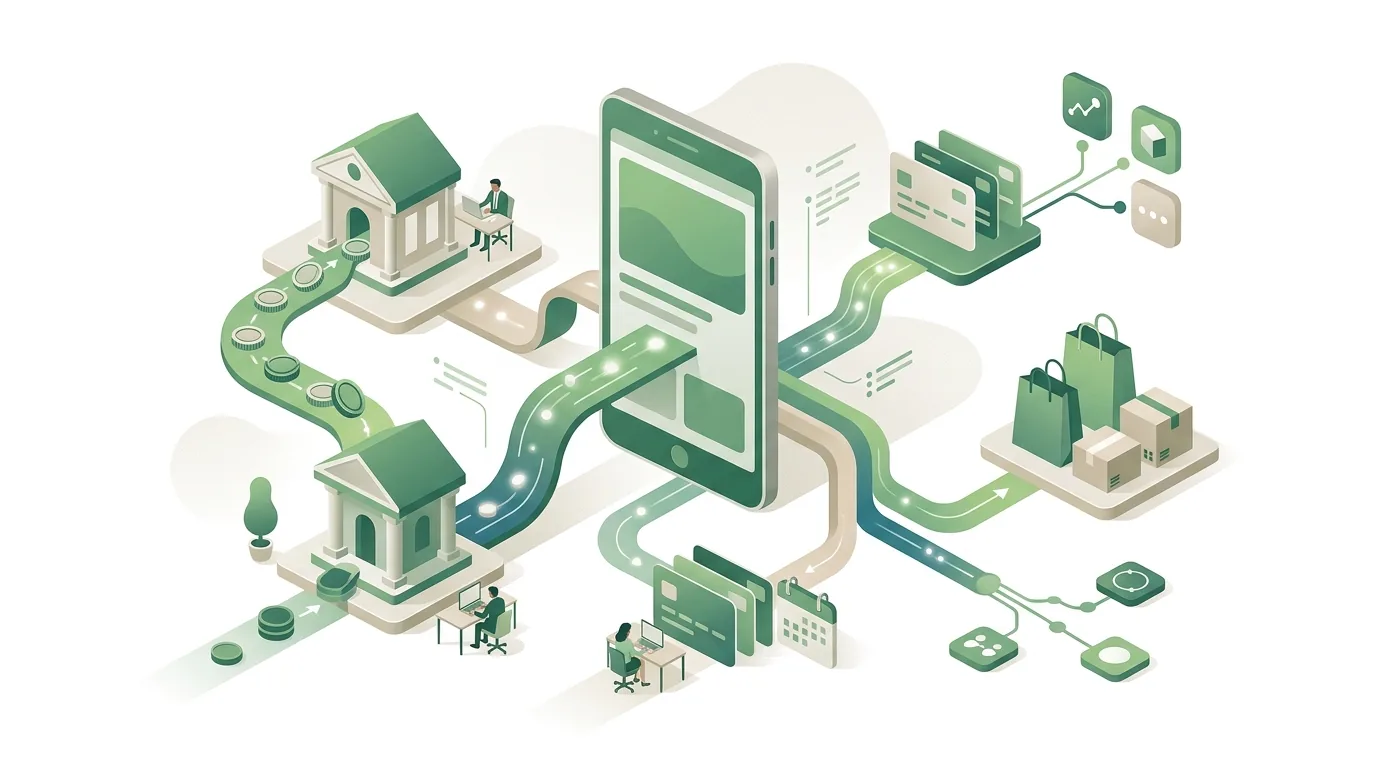
The current top lists in search results keep naming the same kinds of apps. Each one runs on a different business model:
- Survey apps: market research companies pay for opinions about products. Top lists name, for example, Swagbucks, Toluna (which, according to its search snippet, also offers product testing) and LifePoints. You get paid per completed survey. If you don't match the target group they're looking for, you often get screened out after the first few questions.
- Cashback apps: retailers pay a commission on purchases the app refers, and the app passes part of it on to you. iGraal and InboxDollars are named. So you only get money if you were going to buy something anyway.
- Microjob apps: companies pay for small local tasks, such as a photo of a store shelf or a price check. Streetspotr is named. Whether there are tasks at all depends heavily on where you live.
- Fitness and step apps: your steps are converted into points or vouchers. Sweatcoin is named. Most of the time you get rewards rather than cash.
- Gaming and ad apps: advertisers pay for app installs and playtime. Cash Alarm, Mistplay and JustPlay are named. You collect points for reaching levels or watching ads.
- Selling apps: here you sell used items. The money comes from the buyer, not from an advertiser. This is the only kind where you're selling something of real value.
Which one fits whom? Surveys and cashback suit people who knowingly hand over their data and shop online anyway. Microjobs are only worth it in cities with enough tasks. With gaming apps, you pay with your time and attention. If you need a little cash fast, selling used items usually gets you there sooner, because there are no points and no payout threshold.
Which apps actually make you money?
An app only pays real money when three things hold true. First, it has to be clear who's paying. If there's no market researcher, retailer or advertiser behind it, the app may be funding itself through your data or through deposits. Second, the payout has to be transparent: what's the minimum balance, how is it paid out, and do points expire after a certain time? Many apps only pay out once you cross a threshold. If you never reach it, you worked for nothing. Third, you should know what data the app collects. With step and survey apps, your location, your steps and your opinions are exactly what's being sold. You can check this before installing: in the Google Play Store, the "Data safety" section lists what data an app collects and shares; in the App Store, it's under "App Privacy".
Stay away from apps that make you pay something in first so you can supposedly earn more later. One of the top lists in search results even features a token presale as an "insider tip". That's an investment with a risk of loss, not earnings. Nobody gets rich with these apps anyway, and Google's AI Overview for this search says so too. Income from these apps can be relevant for taxes, and anyone receiving parental allowance (Elterngeld) or other benefits should clarify side income beforehand. Whether and how it counts is a question for your tax advisor or the responsible agency.
How does a business make money with its own app?
For businesses, the question runs the other way: which revenue model fits what the app does? The table shows the common models, each assessed by the same criteria.
| Model | How the money flows | Fits when | Where it fails |
|---|---|---|---|
| One-time purchase | Users pay in the store before downloading | The app does one clearly defined job with no ongoing server costs | No more money comes in later for updates and operations, and many users won't download paid apps in the first place |
| In-app purchase | Users buy individual features or content inside the app | The core features are free and there are clearly separable extras | Digital content goes through the store's billing system, which keeps a commission |
| Subscription | Recurring payment, monthly or yearly | The app keeps delivering something new: data, content, service | If the subscription doesn't deliver ongoing value, people cancel |
| Advertising | Ad networks such as Google AdMob pay for impressions or clicks | The app has a very large number of users who open it often | With few users, hardly anything comes in, and personalized ads in the EU generally require consent |
| Selling goods and services | Customers order or book in the app and pay, for example, by card through a payment provider | You already sell products, appointments or services | The app has to offer more than your existing website, or nobody will use it |
| License for business customers | Companies pay per user or location, often by contract outside the store | The app solves a specific problem in an industry | Sales, support and contract management are work that comes on top of development |
| Internal app with no sales | No revenue; the app replaces paper, Excel or double data entry | A workflow demonstrably gets stuck, for example with on-site measurements, timesheets or in the warehouse | If nobody knows how the process works today, the app just digitizes the chaos |
For most mid-sized businesses, one of the last three rows is the way to go. Store sales and ads mainly pay off for consumer apps with a large reach, and you have to build that reach first. Two examples from our own work show the range: for Mundo Marketing, we built a back office with a CRM that doesn't generate revenue of its own but brings internal processes together in one place. Festino, a product of DigifyNow, is a party game app for consumers in the App Store and Play Store, and it's subject to exactly the store rules covered in the next section. How concept, platform choice and development fit together is covered in the article How to develop an app: process, platform and partner.
What rules apply to in-app payments?
For digital goods inside the app, Apple and Google require their own billing systems: StoreKit at Apple, Google Play Billing at Google. Apple sets this out in section 3.1.1 of the App Store Review Guidelines (developer.apple.com/app-store/review/guidelines), Google in the Play Console payments policy. This covers unlocked features, digital content and subscriptions. The store takes a commission on that revenue. On its App Store Small Business Program page (developer.apple.com/app-store/small-business-program), Apple lists a reduced rate of 15 percent for eligible developers; in the Play Console Help article on service fees (support.google.com/googleplay/android-developer/answer/112622), Google lists 15 percent for auto-renewing subscriptions. The terms change, so check the current version before you run any numbers (information as of November 2026).
For subscriptions, Apple specifies in section 3.1.2(a) of the Guidelines that an auto-renewing subscription must last at least seven days and provide ongoing value to the user. A subscription that only unlocks content once won't pass review. Physical goods and services delivered outside the app are a different story, such as an order, an appointment or a contractor's work: under section 3.1.3(e), you may connect your own payment provider for those. Stripe's documentation shows how that works technically.
Ads bring a second rule into play. Under Section 25 of Germany's TDDDG (gesetze-im-internet.de/ttdsg/__25.html), storing or reading information on a user's device requires consent if it isn't strictly necessary for the service, and personalized ad networks do exactly that. On the iPhone, Apple also requires the App Tracking Transparency prompt, described in section 5.1.2 of the Guidelines. How to design the consent in your specific case is something to work out with your data protection advisor.
A common mistake: the payment model gets decided just before submission. If the store rejects the app because digital content is sold through an outside payment method, the purchase flow has to be rebuilt. What else gets checked at submission is covered in the article on publishing in the App Store. One alternative is a web app: it runs in the browser, doesn't need a store and therefore doesn't pay a store commission either. On the downside, it's harder to find, and there are limitations on iPhones.
When doesn't your own app pay off?
In some cases, we'll honestly advise against it. If an app only shows what's already on your website, like opening hours, offers or contact details, hardly anyone will download it. A good mobile website is the better choice then. An ad model doesn't pay off either as long as the app has few users, because ad networks pay per impression or click. And a subscription without ongoing new value gets canceled as soon as the first charge comes through.
But it's not just about the revenue model. An app keeps costing money after launch. Apple and Google regularly require updates for new operating system versions, and on top of that come servers, bug fixes and support. What drives the cost, meaning scope, integrations, data and operations, is covered in the article App development cost: what drives the price. If you first want to test whether anyone will pay for the idea at all, start with an MVP. That's a lean first version with only the core feature, which shows how real users behave. With us, an MVP like that typically takes four to eight weeks. For any specific project, though, that's not a committed timeline.
App development in the Westerwald: What DigifyNow offers
DigifyNow GmbH is based in Unnau in the Westerwald region of Germany, at Grenzweg 9a. We work throughout Germany, but most of our projects come from the Westerwald, Koblenz and the Siegerland. Depending on what you're looking for:
- App development in the Westerwald: we build custom apps for small and mid-sized businesses, from the MVP to a live system with operations and updates.
- App developers in the Westerwald: your contacts are Jesper Schmidt, Christian Schiebl and Miles Pandel. In-person meetings are possible within the region.
- App development agency in the Westerwald: concept, development, store submission and support after launch all come from one team.
- Web app development in the Westerwald: web apps run in the browser without a store, for example as a back office, customer portal or booking system. One example is the back office with CRM we built for Mundo Marketing.
- Mobile app agency in the Westerwald: we build apps for iOS and Android. Our party game app Festino, a product of DigifyNow, is available in the App Store and the Play Store.
You'll find more on the pages App developers in the Westerwald and Web app development in the Westerwald. For an overview, see all services from DigifyNow.
When outside help is worth it
Outside help is worth it if you want to sell an app or use one internally and aren't sure which revenue model fits or whether a web app would be enough. The same goes if an existing app is stuck on store rules or on operations. Have these ready: who will use the app, which process or offering it should cover, which systems need to be connected, and who is responsible for it internally. On our contact page, you can request a free, no-obligation assessment of your project. In it, we work out what makes sense technically and what the costs depend on.
Frequently asked questions
What are some alternatives to Freecash?
The top lists in search results mainly name survey apps like Swagbucks, Toluna and LifePoints, cashback apps like iGraal, the microjob app Streetspotr and gaming apps like Mistplay. The difference is who pays: market researchers, retailers or advertisers. Above all, compare the minimum payout balance, the payout method and the data the app collects according to its data safety section in the store.
How can I make money fast with my phone?
The fastest route is usually selling used items through a selling app. The buyer pays you directly, with no points and no minimum balance. Survey and gaming apps, on the other hand, often only pay out once you reach a certain number of points, and that takes time. Microjob apps pay per task, but only have tasks if there are some near you.
How much commission do the App Store and Google Play take?
It depends on the program. On developer.apple.com/app-store/small-business-program, Apple lists a rate of 15 percent for developers in the Small Business Program; in its Play Console Help article on service fees, Google lists 15 percent for auto-renewing subscriptions (as of November 2026). The commission only applies to digital goods sold through StoreKit or Play Billing. According to the App Store Review Guidelines, physical goods and services delivered outside the app may go through your own payment provider.
Are ads worth it in your own business app?
Rarely. Ad networks pay per impression or click, and meaningful revenue only comes with a very large number of users who open the app daily. A business app for local customers usually doesn't reach that many. In addition, Germany's TDDDG requires consent for non-essential access to the user's device, and on the iPhone, Apple's tracking prompt comes on top. Sales, bookings or a subscription are usually a better fit.
Does an app have to generate revenue to be worth it?
No. An internal app doesn't bring in revenue. It replaces paper, Excel sheets or double data entry, for example for on-site measurements, timesheets or inventory bookings. Whether it pays off shows when you compare it with today's process: how many steps, how many handoffs between paper and systems, how many follow-up questions. Without documenting today's process, there's no serious way to judge that.