Sales Letter: Structure, Example and Rules
· DigifyNow
A sales letter works as a chain. The recipient opens the envelope, reads the opening, and the letter ends by prompting exactly one action: a phone call, a QR code scan or a reply card. So write for a clearly defined group of recipients. Name their problem in the first paragraph, back up the benefit with specifics and close with a response channel you can count. Before mailing, check your address list against the opt-outs you have stored.
What is a sales letter?
A sales letter is an addressed piece of mail that a business sends to a specific recipient to present an offer and ask for a response. That makes it part of direct marketing. What sets it apart from a saturation mailing is the name and address. A saturation mailing goes into every mailbox in an area. A sales letter goes to one person whose address you have because they are a customer, they made an inquiry, or they are on a rented mailing list. Here is a concrete example. A heating contractor writes to every customer whose system it installed several years ago and offers a maintenance appointment. The letter has a sender, a reason (the recipient's own system) and an action (book an appointment). If any of those three elements is missing, the letter is just a brochure in an envelope. How sales letters actually get sent, whether through a lettershop, Deutsche Post's Dialogpost rates or your own printing, and what drives postage costs, is covered in our article Direct Mail: Sending Options, Costs, Examples.
How is a sales letter structured?
Most sales letters are built from the same building blocks. Their order on the page matters less than which block the reader sees first. Google's AI Overview for the German version of this search term, citing heini-marketing.de, says that most readers notice the postscript first or second. So the letter has to work even if someone reads only the subject line, the salutation and the P.S.
| Building block | What it does | Typical mistake |
|---|---|---|
| Sender and letterhead | Shows right away who is writing, with phone number and web address | A logo with no location or contact details, so the recipient can't place the sender |
| Address and personal salutation | Turns advertising into a letter written to this specific person | "Dear Sir or Madam" when the name is known, or a misspelled name from an unchecked list |
| Subject line or headline | States the benefit or the occasion in one line | Company or product name instead of a reason to keep reading |
| Opening | Picks up the recipient's problem or situation | A first paragraph about your own company history |
| Body with benefits | Translates features into what the recipient gets out of them | A list of technical specs with no link to the reader's day-to-day life |
| Call to action | Asks for exactly one next step, with a deadline | Three different ways to get in touch, no deadline, no reason to act now |
| P.S. and response device | Repeats the core argument and provides a reply card, QR code or phone number | A P.S. that brings up a new topic, or a QR code that leads to the home page instead of a matching page |
How to write a sales letter, step by step
If you want to write a sales letter, don't start with the copy. First decide who the letter should reach and how you will later tell whether it got a response. Without that, you have no way to compare one letter with another.
- Define your recipients: a group that shares an occasion, such as existing customers with systems from a certain year or businesses in one industry in one region. The narrower the group, the more specific your opening can be.
- Set the goal and the measuring point: a call, an appointment, an order or a visit to a web page. Each version of the letter gets its own response identifier, meaning its own QR code, coupon code or direct phone extension.
- Settle the content before the wording: What problem does the recipient have, what offer solves it, and why should they respond now? If you can't say that in three sentences, better copy won't help.
- Write the first draft: subject line, opening, benefits, call to action, P.S. Keep paragraphs short, one idea per paragraph, and address the reader directly throughout.
- Have someone else proofread it: they read only the subject line, the salutation and the P.S., then tell you what the letter wants from them. If they can't, the copy needs another round.
- Check the address list: remove duplicates, update addresses and exclude any stored opt-outs.
- Run a test before the full mailing: send to a subset, count returned mail and responses per identifier, and only then release the rest.
If the QR code leads to a web page, that page decides what happens next. It should pick up the letter's headline and have a short form. What typically goes wrong there is covered in Landing Page Optimization: 7 Steps and Mistakes.

Sales letter example: a maintenance offer from a trade business
The following sales letter example is entirely made up. It shows the building blocks applied to a typical occasion at a small or midsize business. Neither the company nor the person exists.
Subject: Your heating system is due for maintenance – book before winter. Dear Ms. Example, we installed your heating system back then. For systems of this age, maintenance is worth doing before the cold season starts, because that's when appointments get scarce and a breakdown hits just when you need the heat. During maintenance we check the burner, the pressure and the safety devices, and afterwards we tell you in writing whether anything needs to be done and when. Scan the QR code below or call our direct line to pick an appointment. Sincerely, Max Muster, Heizungsbau Muster GmbH. P.S.: We assign pre-winter appointments in the order we receive requests.
Why the letter is built this way: the subject line names the occasion, not the company. The first sentence explains why this particular recipient is getting the letter. The benefit is described as a concrete procedure rather than a claim. There is exactly one action, and the P.S. gives a reason to take it soon. This letter would not work for cold addresses, because without a shared history the first sentence no longer holds up.
Is direct mail advertising allowed?
In Germany, where we are based, addressed mail advertising is generally permitted without prior consent. Stricter rules apply to marketing emails and sales calls. The line is drawn by the German Act Against Unfair Competition (UWG): advertising counts as an unreasonable nuisance when it is clear that the recipient doesn't want it. With rented or purchased addresses, the General Data Protection Regulation (GDPR) also comes into play. It gives every person the right to object to the processing of their data for direct marketing; once they object, their data may no longer be processed for that purpose. If the data did not come from the person themselves, the regulation also sets out what they must be informed about, such as where the address came from.
This has a technical consequence: an objection must not lead to the address being deleted. It has to stay on file as a suppression flag, otherwise the same person shows up again with the next list import. In a CRM, that is a dedicated field that every marketing export checks. How deleting and suppressing work together there is explained in What Is CRM? Definition, System and Example. A "No advertising" sticker on a mailbox mainly applies to unaddressed mailings. For addressed letters, the situation is less clear-cut. This is not legal advice: whether a specific mailing is permitted depends on your address source and your process, and if in doubt it should be reviewed by a lawyer.
What are the advantages of letters, and when are they not worth it?
A letter has three qualities that digital channels lack. It doesn't pass through a spam filter; the postal service delivers it. It stays around physically, often on a desk or a bulletin board. And as addressed advertising, it doesn't need prior consent the way a marketing email does. On top of that, with a separate code for each version, it is just as measurable as an online campaign.
But there are cases where a sales letter isn't worth it:
- The offer only runs for a few days: printing, inserting and delivery all need lead time, and the deadline passes before the letter is read.
- The address list is old or unchecked: people move, mail comes back, and every returned letter costs printing and postage with no effect.
- There is no measurable response channel: without a separate identifier per letter, you won't know afterwards whether a call came from the letter or from the website.
- Nobody follows up on the responses: if callbacks and forms sit unanswered, the response fizzles out.
- The target group is fuzzy: a letter to every business in a region can't have a specific opening and turns into a brochure.
Triggering sales letters automatically: LetterFlow
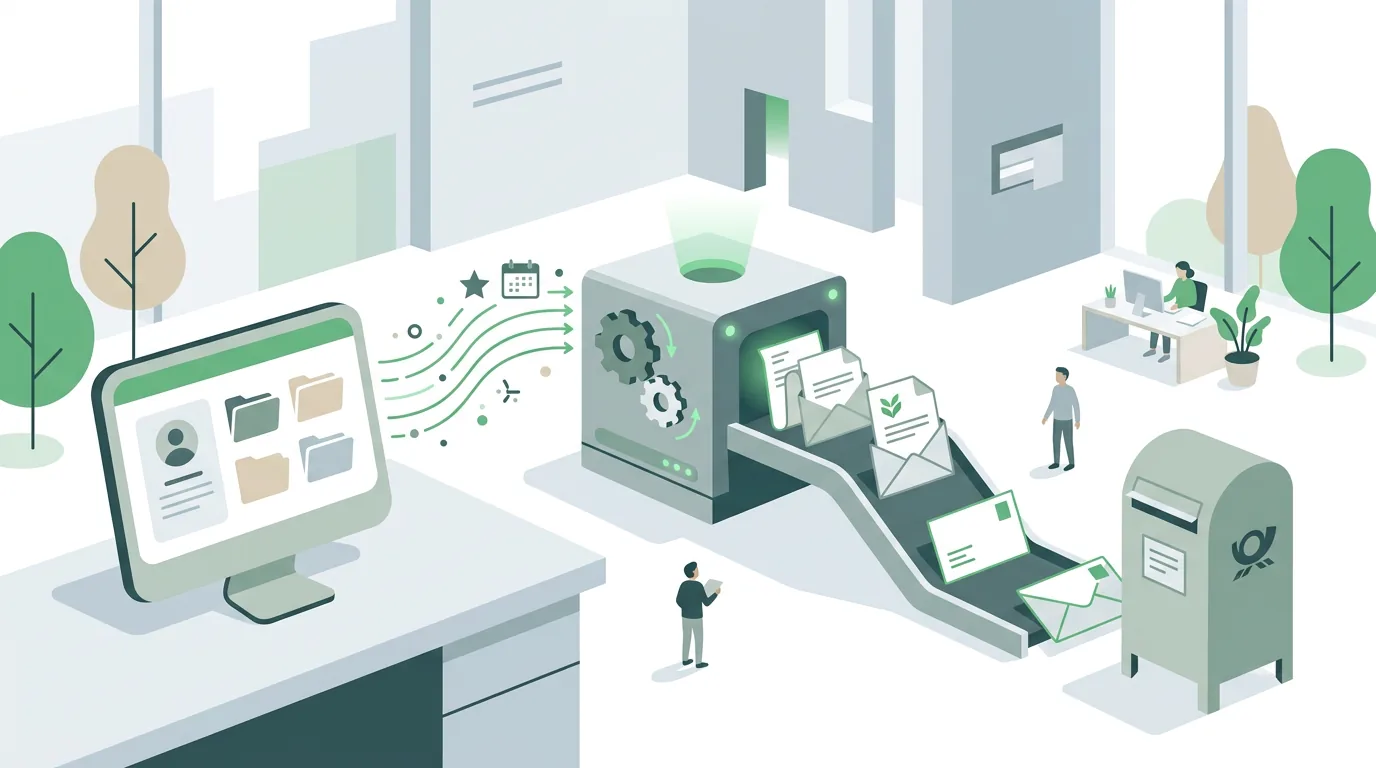
LetterFlow is a product of DigifyNow for automated letter mailing. The idea behind it: a sales letter doesn't have to be planned as a one-off campaign. It can also be triggered by an event, such as a new customer, a maintenance appointment coming due, or an inquiry that didn't close. Then the letter no longer has to be put together by hand in Word, at the printer and at the folding table. Here too, it matters that suppression flags are checked before every trigger. Which data source gets connected, and whether the effort pays off for your volume of letters, is something we clarify up front. If you only send a few letters a year, the manual route is often enough. How letters are combined with email and other channels into a sequence is shown in Marketing Automation: Tools and Examples. Our direct marketing services are described on the page about direct marketing with letters and automation.
When outside help makes sense
Most businesses write a single sales letter to existing customers themselves, and that's exactly as it should be. Outside help is worth it when letters should be generated regularly from customer data, when several versions need to be tested and evaluated, or when the letter, landing page and CRM have to work together. For that, bring along your address source, the rough number of letters per year, the goal of the letter and the customer system you use today. In a free, no-obligation assessment of your project, we look together at which approach fits your situation, including whether automation is worth it at all.
Frequently asked questions
How long should a sales letter be?
One page is enough for most occasions. What matters, though, isn't length but whether the letter still makes sense when only the subject line, the salutation and the P.S. are read. Offers that need explaining can run longer, as long as every paragraph carries its own benefit. Technical details then belong in an insert or on the page behind the QR code.
How much does a sales letter cost?
The cost is made up of copywriting, design, printing, inserting, postage and, where applicable, list rental. The size of the mailing spreads the fixed costs for copy and design, format and weight determine postage, and personalization beyond the name adds effort at the printing stage. You only get a firm figure from a quote by a lettershop or the postal service for your mailing size.
Sales letter or marketing email: what's the difference?
The biggest difference is consent. Addressed mail advertising is generally permitted as long as the recipient hasn't objected. Under the German UWG, marketing emails usually require prior express consent, with a narrow exception for existing customers. In return, a letter has lead time and a cost per piece, while email is faster but has to get past the recipient's spam filter.
How do I advertise my business?
Start with the question of where your customers already are, not with the channel. Existing customers are easy to reach by letter or by a newsletter they have opted into. People who are actively searching are reached through search ads and a matching website, and cold contacts in a region through addressed letters. Every channel needs its own measuring point, otherwise you can't compare what triggered an inquiry.