Digital Transformation Strategy: Steps & Example
· DigifyNow
A digital transformation strategy sets out which processes you digitize, in what order, and how you will know it worked. It does not start with software. It starts with your bottleneck and your master data. From those you set a goal you can check, name one person who owns it, and pick a small first step with a stop criterion. After that, you review at fixed intervals whether the order still makes sense.
What is a digital transformation strategy?
A digital transformation strategy is a written plan. It says which processes a company will run digitally and in what order, which system is the source of truth for which data, and how progress will be measured. It starts with the bottleneck in your operations, not with software, so it is not a software shopping list. First the strategy names the problems, such as quotes that sit for days or customer data kept in several Excel spreadsheets. Tools come later. For what digitalization actually covers, from scanning paper to a fully connected process, see our article on the definition of digitalization.
In everyday use, "digital strategy" and "digital transformation strategy" often mean the same thing. People who separate them usually mean the outward view by digital strategy: new digital products, sales channels, marketing. A digital transformation strategy in this narrower sense looks inward, at processes, data and systems. An IT strategy is narrower still. It covers infrastructure, licenses, security and operations. For most small and midsize businesses this split isn't worth the trouble. One document is enough, as long as it covers internal processes and customer contact together.
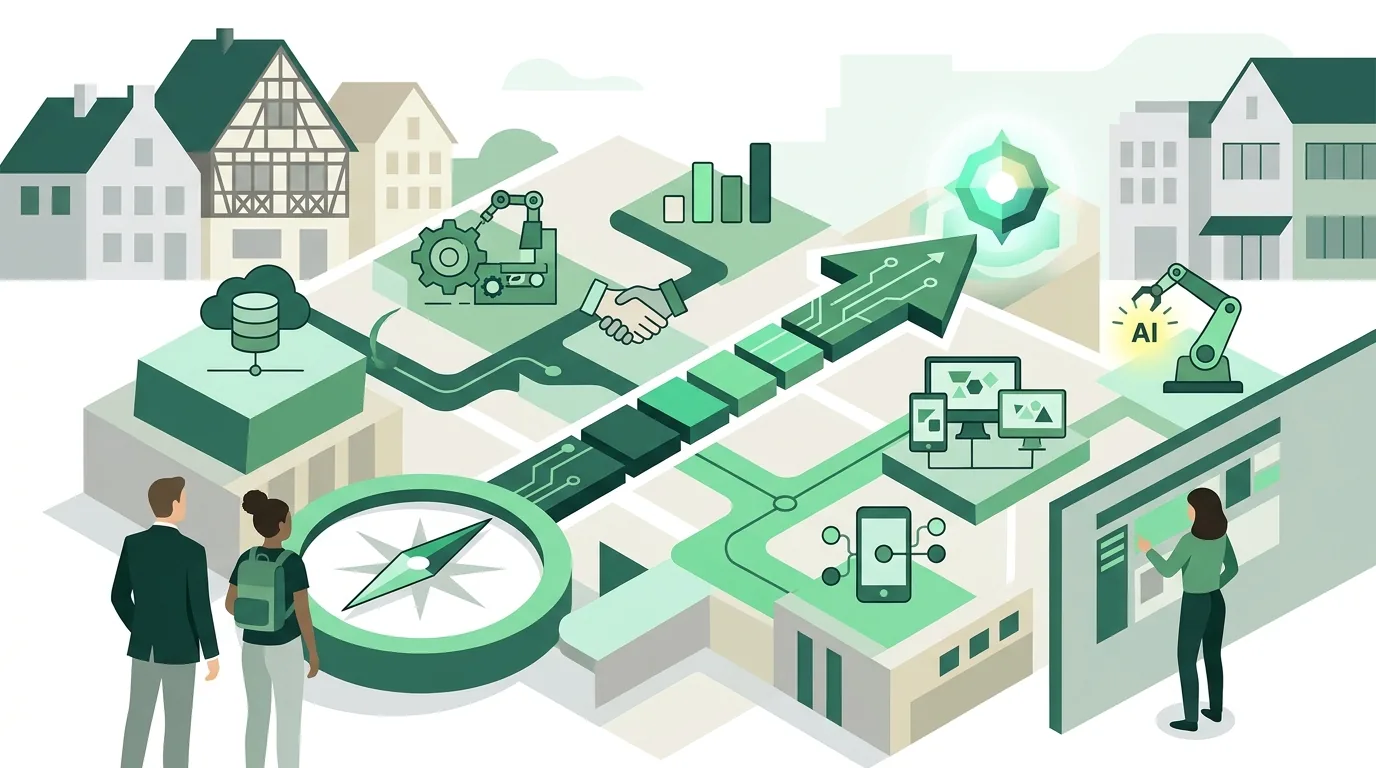
What goes into a digital transformation strategy for a business?
A company's digital transformation strategy doesn't need a set number of pages, but it does need six building blocks. If one is missing, you have a statement of intent rather than a strategy. The table shows the question each block has to answer, what it should produce, and the mistake people make there most often.
| Building block | Question it answers | Output | Typical mistake |
|---|---|---|---|
| Current-state review | How do the key processes run today, with which tools, and where do things get re-keyed between paper, email and systems? | Process map and a list of systems with the data each one holds | Listing software instead of describing processes |
| Bottleneck | Where does the business lose time, orders or visibility today? | A few prioritized processes, one of which goes first | Trying to tackle everything at once |
| Goals | How will we know things have improved? | A metric with a baseline, e.g. turnaround time for a quote | "Become more efficient" as a goal nobody can check |
| Data | What master data exists, where does it live, who maintains it? | One source-of-truth system per data type (customers, products, orders) | The same customer data in several systems with no sync |
| Execution | What comes first, who owns it, what is the smallest step that makes sense? | A sequence with owners and a stop criterion | One big project with no checkpoints |
| Review | When and by whom is the sequence reassessed? | A fixed date on the calendar with a named person | The strategy gets written once and never opened again |
The data block is the one most often underestimated. If nobody can say which system has the final word on customer data, every new piece of software just makes the mess bigger. How to assess your starting point in a way others can follow is covered in our article on digital maturity and how to measure it.
How to build a digital transformation strategy in six steps
The sequence below works without a strategy department. In a business with a handful of managers, you can work through it yourselves.
- Map your processes: Draw the key processes from trigger to result, for example from inquiry to paid invoice. At each stage, note whether paper, email, Excel or a dedicated system is involved. Every switch between these is a source of errors, because data gets retyped or copied there.
- Pick the bottleneck: Ask the people who run the process every day where it gets stuck. Pick the process where delays cost money or customers. It is rarely the one that is most interesting to solve technically.
- Set a goal with a baseline: Before you start, measure how long a task takes today or how often follow-up questions are needed. Without a baseline you can't tell later whether anything has improved.
- Settle data ownership: For customers, products and orders, name one source-of-truth system each. Add who maintains the data and how other systems read it, through an integration (API) or a scheduled export.
- Decide on the tooling route: Only now do you choose whether off-the-shelf software fits, a low-code solution is enough, or you need a custom application. The requirements for that belong in a requirements document.
- Start small and review: Roll out the first process in a limited area, such as one team or one product line. Decide beforehand which result will make you stop or change course. Only then do you take on the next process.
Two articles help with step 5: one on a requirements document with must-have, should-have and nice-to-have criteria, and another on whether custom software or a SaaS subscription makes more sense. If at step 6 it's unclear whether an idea works technically at all, a proof of concept before the actual build is often the cheaper route.
Digital transformation strategy: an example
The following example is made up and only shows how the building blocks fit together. It does not describe a real project. A wholesale distributor of plumbing and HVAC supplies has a field sales team and a warehouse. The current-state review turns up the following: field reps write orders on paper or in their phone's notes app. In the office they get retyped. Inventory lives in the ERP system, but nobody can see it on the road.
- Bottleneck: Orders don't reach the system until the next day. Questions about out-of-stock items get back to the customer after the rep has already promised delivery.
- Goal: An order is in the system the same day. The baseline is today's time from visit to order entry, measured over a set period before the start.
- Data: The ERP stays the source of truth for products and inventory. The CRM is the source of truth for contacts and visit reports. No third system with its own product data gets created.
- First step: an order entry form on tablets that reads inventory from the ERP. It is tested first with a small part of the field sales team. Stop criterion: by the end of the agreed test phase, the reps aren't using the form voluntarily.
- Deliberately put on hold: an online store for end customers and AI-assisted quote creation. Both go on the list only once the product data is clean.
The key part of the example is the on-hold list. You can tell a real strategy by what it leaves out for now. More processes from sales, accounting and service are in our collection of digitalization examples for businesses.
What are the stages of digital transformation?
There is no binding stage model. No standard defines the stages of digital transformation, and the models from consultancies, industry associations and universities slice them differently. Most still follow the same logic: first, information is captured digitally (scanned receipts, for example), then individual processes run digitally, then systems get connected. After that, data is used for decisions, and at the end there are sometimes new, digital business models.
For your strategy, the main lesson of these stage models is that later stages build on earlier ones. If you put reports or AI assistants on top of data that still sits in separate spreadsheets, you get contradictory results. But a company doesn't have to be equally far along everywhere. Accounting can be fully digital while the job site still runs on paper. What that looks like in practice is covered in our article on digital transformation for contractors.
How does digital transformation affect employees?
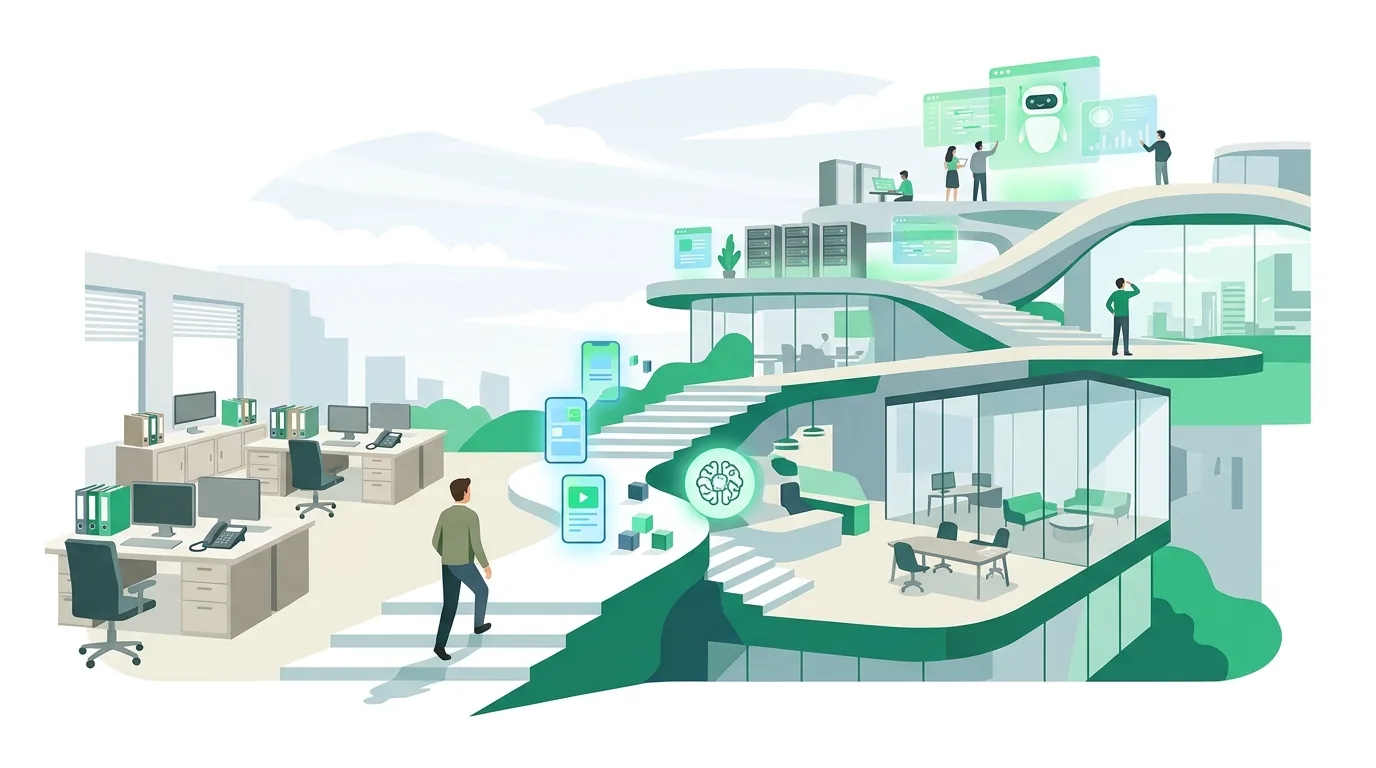
For staff, digitalization mostly changes routines: where information lives, who enters what, when something counts as done. Pushback is rarely about the technology itself. Usually it comes from a new system asking for extra data entry while people aren't allowed to drop anything old in return. So for each process, a strategy should say which spreadsheet or form goes away. The people who run the process every day should be involved from the current-state review on, not just at training time.
If the strategy includes AI systems, a legal requirement comes on top. In its currently applicable, amended version, the EU AI Act requires providers and deployers of AI systems to take measures. These are meant to support the development of AI literacy among their staff and other people who operate and use such systems on their behalf. They are not required to guarantee a particular level of AI literacy for any person. How you design those measures is up to your own business. The text of the regulation is published in the Official Journal of the EU.
Which EU AI Act deadlines matter for sequencing?
The AI Act applies in stages. For planning, that means every AI project in your strategy should be checked against the date from which the relevant rule applies. Check the exact dates in the current version in the Official Journal of the EU. The table shows which rules exist and what they mean for your sequence.
| Rule | When it applies | What it means for the strategy |
|---|---|---|
| Measures on staff AI literacy | Already applies, in amended form | AI literacy measures belong in every AI project, e.g. training before an assistant goes live |
| Transparency obligations for systems that generate text, images, audio or video | Already applies; for systems already on the market before that, with a transition period for providers | When using existing tools, ask the vendor how they implement labeling |
| Rules for high-risk systems | Apply later, on different dates depending on which annex of the regulation a system falls under | Clarify how a planned system is classified before you choose it, not during rollout |
If your strategy includes, say, AI-assisted candidate screening, the classification question belongs in planning. The table is no substitute for confirmation that a specific system meets the requirements. That takes a legal review of the individual case.
Why do digital transformation strategies fail?
- Software before process: A system gets bought first, then the business is bent to fit it. If the system's fields and statuses don't reflect how you actually work, side spreadsheets in Excel appear.
- No owner: If the strategy belongs to "everyone," nobody has time for it. Each process needs one person with decision-making authority and hours set aside.
- Goal without a baseline: Without a measurement before the start, every assessment is gut feeling, and the discussion goes in circles.
- Unclear data ownership: Two systems with their own customer records drift apart. By invoicing time at the latest, wrong addresses show up.
- Too much at once: Running several rollouts in parallel overloads the same key people. Then none of them gets finished.
- No review: There's no fixed date for reassessing the sequence. The strategy goes stale while the business changes.
A detailed strategy isn't always worth it, by the way. A business with one obvious bottleneck, such as appointment scheduling, can tackle that one process directly. The strategy document would then be half a page. More effort is needed once several departments work with the same data. Where to start in a small or midsize business is covered in our article on small business digitalization: where to start.
Putting your digital transformation strategy into practice with DigifyNow
DigifyNow, based in Unnau in Germany's Westerwald region, supports small and midsize businesses with their digital transformation strategy, from the current-state review to a running system. We start with the bottleneck process and the data; tools come after that. If off-the-shelf software fits, we say so. If a custom application is needed, the first thing built is often an MVP, a first usable version, which according to our service offering takes four to eight weeks. Whether that's realistic for your project only becomes clear in the assessment. How the consulting works is described on our digital transformation consulting page, and the individual building blocks, from apps to AI automation, are in the overview of our services.
What the data building block looks like in practice is shown by our project for Mundo Marketing: a custom back office with an integrated CRM. Contacts and the processes around them sit in one system there instead of separate spreadsheets. That exact question of which system is the source of truth was where it started. A second example from our own shop is Tablify, a product by DigifyNow. It brings together menus, gift cards and analytics for restaurants via QR code. The same principle shows up on a small scale: the menu is maintained in one place, and everything else reads from it.
When outside help is worth it
Outside help pays off mainly in two cases: when several departments use the same data and nobody in-house has an overview of the integrations between systems, or when it's clear that a custom application or AI automation will be needed. If the bottleneck is clear and there's suitable off-the-shelf software for it, many businesses manage on their own. For the conversation, bring the key processes in bullet points, the list of systems you use, and a rough idea of the goal. In the free, no-obligation assessment of your project, we discuss what should come first and whether you need support at all.
Frequently asked questions
Digital transformation strategy vs. IT strategy: what's the difference?
A digital transformation strategy defines which processes should run digitally, in what order, and which metric with a baseline is used to check progress. An IT strategy, by contrast, covers infrastructure, licenses, security and operations. The first starts from processes and data, the second from systems. For an SMB, a digital transformation strategy often fits on a few pages, as long as every process has an owner and a stop criterion.
How do you create a digital transformation strategy?
In six steps: map the key processes and where data gets re-keyed between media, pick the bottleneck, set a goal with a measured baseline, name one source-of-truth system each for customers, products and orders, then decide on the tooling route (off-the-shelf, low-code or custom build) and start small with one team. A fixed review date with a named person is part of it from day one.
How digitalized are businesses in Germany?
Reliable figures are published by Germany's Federal Statistical Office (Destatis) and the European Commission in its Digital Decade reports. An average figure does little for your own business, though. Even within one company, departments differ widely: accounting may already be digital while order intake is still on paper. For your own strategy, what counts is the state of your own processes, measured by media breaks and duplicated data.
How much does a digital transformation strategy cost?
There are no fixed amounts. Costs depend on how many processes and departments the current-state review covers, how many systems and integrations are looked at, and how much you work out internally yourselves. Later come the costs of implementation: licenses, customization, data migration and ongoing operations. A firm figure only comes out of a clearly defined scope.
Who should own the digital transformation strategy?
In SMBs, the managing director or owner should own the strategy, because they decide on sequence and budget. IT can't take that role. Each individual process also needs a person responsible on the business side, such as the head of sales for quote creation, with working time set aside. If ownership sits with IT alone, the strategy easily turns into a plan for systems rather than for processes.
How often should you review the strategy?
On a fixed calendar date that a named person is responsible for. That's when you check whether the current step is reaching its goal and whether the order of the next processes still makes sense. Unlike creating the strategy, the review is short: metric against baseline, then a decision to continue, change course or stop. Reasons for an unscheduled review include a new core system or a new obligation such as mandatory e-invoicing.
Which EU AI Act deadlines belong in a digital transformation strategy?
Three rules: the obligation to take measures on staff AI literacy already applies; it does not require a guaranteed level of literacy. The transparency obligations for systems that generate text, images, audio or video also already apply, with a transition period for older systems. The high-risk rules come later, staggered by type of system. If you plan to use AI, clarify the classification before choosing a system and check the dates in the current version in the Official Journal of the EU.